Occasions
Most reliable used cars in 2026: what the TÜV Report shows
The most reliable used cars in 2026 per the TÜV Report: ranking by category, models to avoid and Belgian market prices, with dated figures.
Looking for a used car that won't let you down in two years? As of this article (July 2026), the TÜV Report 2026 puts the Mazda 2 first with 2.9% faults at 2–3 years, followed by the Toyota Yaris and Corolla hybrids. At the other end, the Tesla Model Y posts the worst score in a decade.
The TÜV report is the most consulted reliability dataset in Europe, but you have to read it right — and adapt it to the Belgian market, where the Car-Pass and the roadworthiness test change the picture. Here is what the numbers actually say.
Which used car is the most reliable in 2026?
The Mazda 2 is the most reliable used car in the 2026 edition, with 2.9% significant faults found during roadworthiness tests on 2-to-3-year-old vehicles.
Behind it, the leading trio is Asian: Toyota Yaris Hybrid around 2% per TÜV data, Toyota Corolla Hybrid at 3%. All three share simple, proven mechanicals with little superfluous electronics. That is exactly what the TÜV measures: not driving pleasure, but how often a part fails at inspection time.
On the Belgian market, this hierarchy matters twice over. A Yaris Hybrid resold after three years keeps a high value on 2ememain.be and Autoscout24.be, which offsets its higher purchase price. In practice, that means a more predictable cost of ownership: fewer unexpected repairs, an easier resale.
How does the TÜV Report 2026 measure reliability?
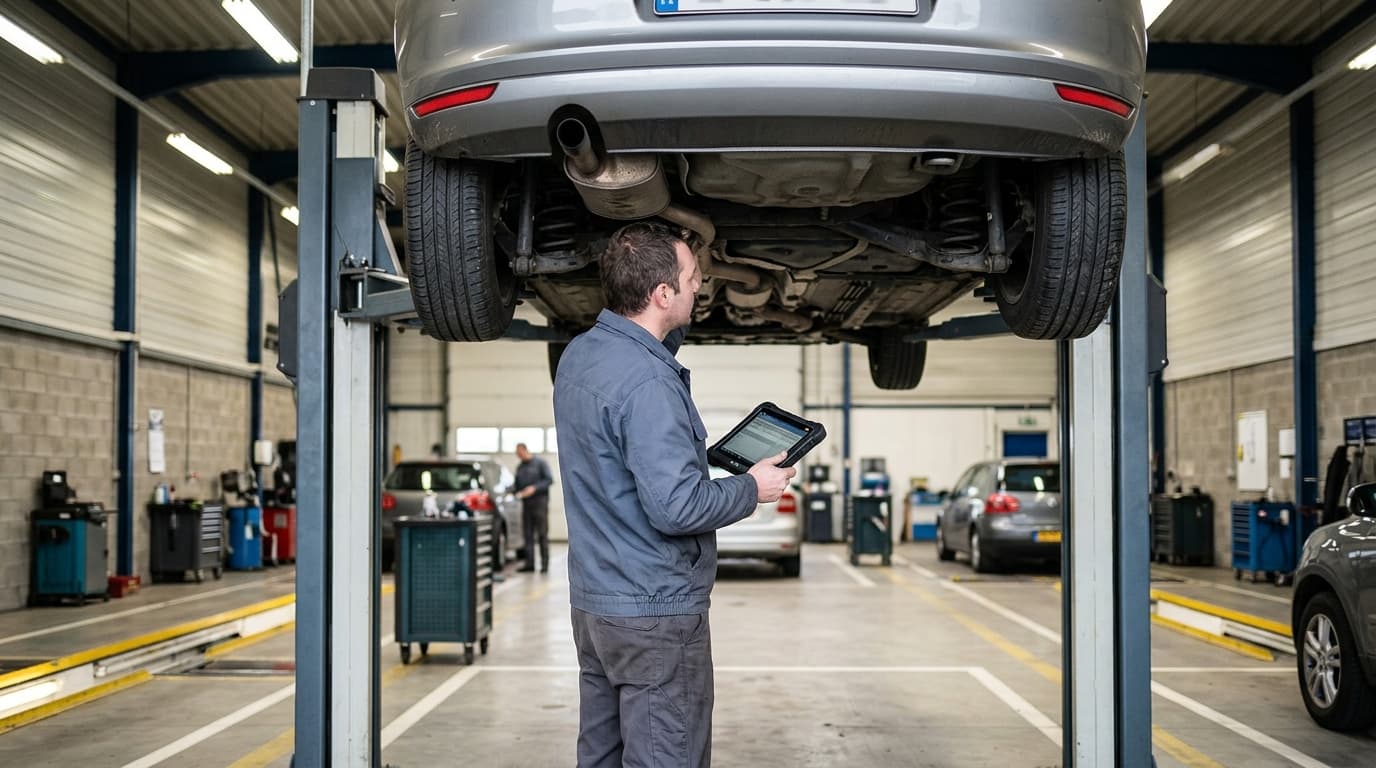
The TÜV Report compiles the real results of German roadworthiness tests: nearly 9.5 million inspections carried out between July 2024 and June 2025, across 216 models.
In concrete terms, every car that passes the German roadworthiness test is graded. The TÜV then calculates, by model and age bracket, the percentage of vehicles failed for "significant faults" — brakes, steering, suspension, lighting, running gear. The lower the rate, the more reliable the model over time. This is field data, not lab tests or satisfaction surveys.
The figure that really counts: these are the same models sold in Belgium. A Golf or a Yaris tested across the border is mechanically identical to the one at your Brussels dealer. TÜV data shows that reliability depends mostly on servicing and model year — two things you can check before buying.
Which used city cars and compacts break down the least?
Reliable city cars and compacts cluster around Mazda, Toyota and, for electric, Fiat. Here are the TÜV 2026 fault rates by category, on 2-to-3-year-old vehicles.
| Category | Most reliable model | Fault rate (2–3 yrs) |
|---|---|---|
| Small compacts | Mazda 2 | 2.9% |
| Hybrid city car | Toyota Yaris Hybrid | ~2% |
| Electric city car | Fiat 500e | 5.4% |
| Compact | BMW 1 Series | 5.8% |
| Saloon | Mercedes C-Class | 6.2% |
| MPV / van | Mercedes B-Class | 3.0% |
Two lessons. First, the gap between the best and the worst in a single category often exceeds 10 points: model choice matters more than luck. Second, electric is not automatically reliable: the Fiat 500e does well at 5.4%, but stays far behind the Toyota hybrids. The battery, though, behaves well — most makers warranty 70% capacity over 8 years or 160,000 km.
A concrete Belgian example: a 2023 Mazda 2 goes for around €15,000–17,000 in July 2026, with a near-unmatched fault rate. What we'd avoid at that budget: a German premium compact over five years old with no full service history.
Which used models should you avoid in 2026?
Three families of models concentrate the nasty surprises: certain PureTech engines, several British premium SUVs and a few dual-clutch automatic gearboxes.
The Peugeot 208 and 308 in 1.2 PureTech, model years 2019–2021, suffer from fragile head gaskets and timing chains. Stellantis fixed the issue on 2022-onward versions, but used examples from that period without a full service book stay risky. The Range Rover Evoque and Discovery Sport 2015–2020 combine temperamental electronics with heavy repair bills once the factory warranty expires. Finally, the VW dry DSG DQ200 gearboxes (2012–2018) have a clutch prone to premature wear; post-2019 versions are safer.
On the Belgian market, these models often resell at a discount — which is no bargain if a €2,000 repair is waiting for you. TÜV data shows that model year and servicing make all the difference: the same model can be reliable or troublesome depending on the production year.
Why does the Tesla Model Y post the worst score in 2026?
The Tesla Model Y records 17.3% faults at 2–3 years in the TÜV Report 2026, the worst result in a decade for a car of that age.
The reported faults are mostly lighting, running gear and brake wear. The likely cause: the car's high weight combined with regenerative braking that sometimes lets the discs oxidise, and manufacturing tolerances still to be refined. It is not a battery or powertrain problem, but rather assembly and running gear.
Should you flee the used Model Y then? Not necessarily. Most of these faults are cheap to fix and easy to spot at a pre-purchase inspection. In practice, that gives a simple rule on the Belgian market: a used Model Y is negotiable, and its inspection deserves a visit to a specialist before you sign.
How much do these reliable used cars cost on the Belgian market?
The most reliable used cars cost a little more to buy, but their gentler depreciation balances the bill over time. Here are the ranges recorded in July 2026 on 2ememain.be, Mobile.be and Autoscout24.be.
| Model | Used price ~3 yrs | TÜV fault rate |
|---|---|---|
| Dacia Sandero | €9,000–12,000 | ~6% |
| Mazda 2 | €15,000–17,000 | 2.9% |
| Toyota Yaris Hybrid | €17,000–20,000 | ~2% |
| Toyota Corolla Hybrid | €24,000–28,000 | 3% |
| Fiat 500e | €13,000–16,000 | 5.4% |
| Toyota RAV4 Hybrid | €30,000–35,000 | < 5% |
The figure that really counts: a Toyota hybrid depreciates more slowly, so it costs more used — but you resell it better. On the Belgian market, always demand a clean Car-Pass (mandatory for any sale between private sellers and dealers in Belgium, it certifies the real mileage) and a recent roadworthiness test. To compare models side by side against your budget, our comparison tool does the sorting.

Our verdict: reliability isn't everything
If you want the lowest risk, a Mazda 2 or a Toyota Yaris Hybrid from 2022–2023 is the safest bet: minimal fault rate, cheap servicing, preserved resale value. On a tight budget, a recent Dacia Sandero stays a fair value, provided you check its history.
Our alternative for a family: the Toyota RAV4 Hybrid 2021–2022, under €35,000, combines reliability and space. But no TÜV ranking replaces two essential Belgian checks: a clean Car-Pass and an independent mechanical inspection (€60–150) before any purchase above €10,000.
To go further, see the ranking of the most reliable used cars, or compare the best hybrids of 2026 if efficiency comes first.
Sources: TÜV Report 2026 (nearly 9.5M inspections, July 2024–June 2025); ADAC Autotest 2025; Car-Pass Belgium; price survey on 2ememain.be, Mobile.be and Autoscout24.be (July 2026); Moniteur Automobile.
Comparateur Occasions
Compare tous les occasions côte à côte.
Comparer maintenant →
Frequently asked questions
Julien essaie des voitures depuis 2012, d’abord pour la presse spécialisée belge, aujourd’hui en indépendant depuis Liège. Il croise les données TÜV, ADAC et les prix catalogue belges plutôt que les fiches constructeur. Sa règle : pas d’essai en concession de 20 minutes, pas de verdict sans chiffre vérifiable.