Électriques
Electric vs Hybrid 2026: What's the Real Total Cost?
Electric or hybrid in 2026? Real 5-year total cost compared in Belgium: purchase price, energy, maintenance and company-car tax. Our data-backed verdict.
A hybrid is cheaper to buy, an electric car is cheaper to run. The real contest is settled on total cost. On the Belgian market in 2026, an EV charged at home recovers its purchase premium in 6 to 7 years for a private buyer, and much faster for a company car. Here is the calculation, with dated figures, and the case where a hybrid still wins.
Electric or hybrid: which costs less in 2026?
Over the ownership period, electric. It starts with a roughly €7,000 purchase handicap versus an equivalent hybrid, but it pays that back through energy and maintenance. The break-even point is about 6 to 7 years for a private buyer, and it drops below 4 years with a regional incentive or company-car tax.
Total cost of ownership adds up four items: purchase price, energy, maintenance and tax. The hybrid wins the first, the EV wins the other three. The whole question is how long you keep the car and how many kilometres you drive: the more you drive, the more the EV pulls ahead.
In practice, that draws a fairly clear line. A high-mileage driver who charges at home has every reason to go electric. Someone driving 8,000 km a year with no charger at home keeps a better case with a regular hybrid. The rest of this article prices each item so you can place your own case. For the full tax and technical context, see our Belgium blog coverage of the 2026 rules.
What is the purchase premium of an EV versus a hybrid?
Count on about €7,000 between a regular hybrid and a comparable-size EV. A Toyota Corolla 1.8 Hybrid starts at €29,990 incl. VAT (Toyota Belgium, 2026), while a compact EV like the Renault Megane E-Tech sits around €37,000.
The gap varies by segment. On city cars it narrows: a Citroen e-C3 EV at €19,990 is not far from an urban hybrid. On family cars and SUVs it widens, because big batteries are expensive. The rule holds: at equal size, an EV needs a higher purchase budget — that is the price of the battery.
The number that really matters: this premium is not lost, it is a cash advance that usage pays back. What we'd avoid is comparing two cars on list price alone. A €30,000 hybrid burning 5 L/100 km and a €37,000 EV charged at home do not cost the same at all after five years.
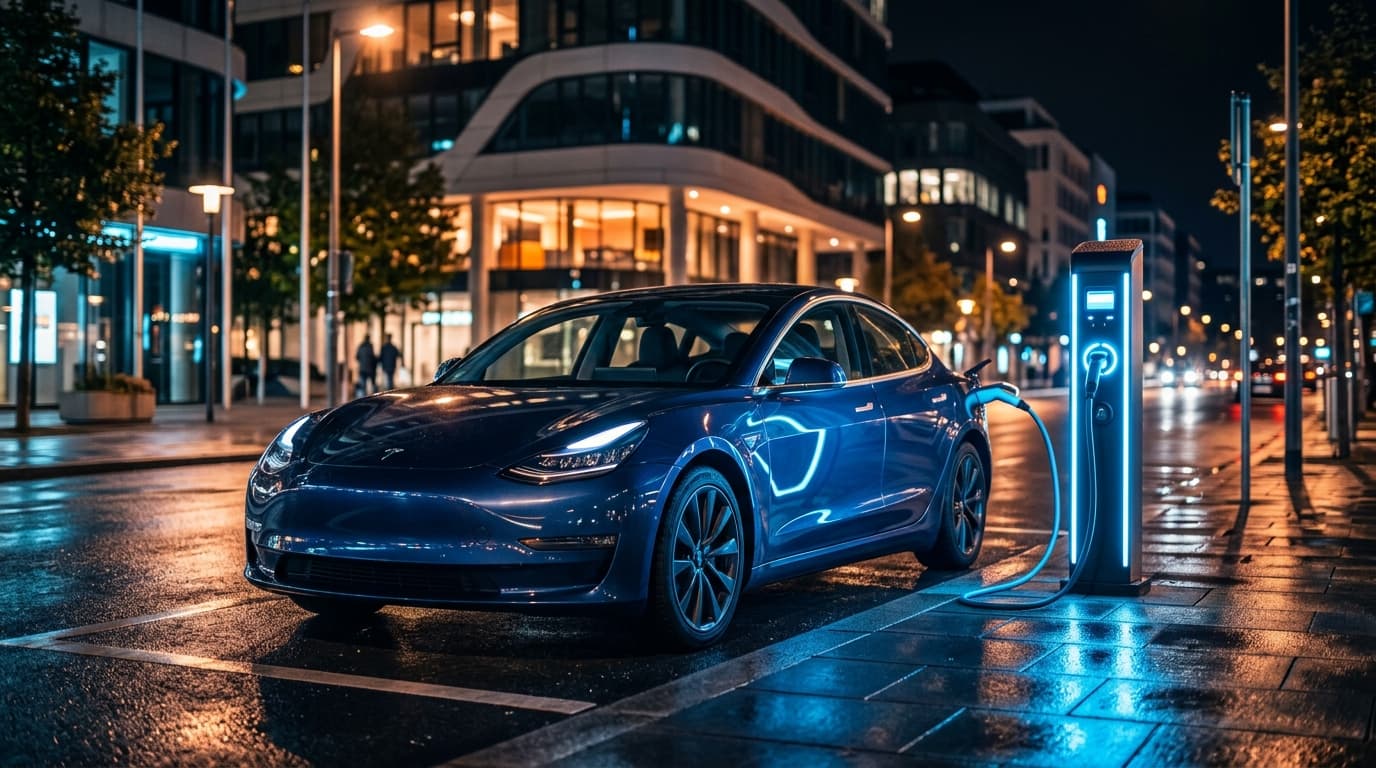
How much does energy cost: EV charging vs petrol hybrid?
The EV wins clearly, provided you charge at home. At home, count on €4.50 to €8 per 100 km depending on your tariff. A regular hybrid at 5 L/100 km comes to about €9 per 100 km, with 95 E10 petrol at €1.806/L (official maximum price, 26 June 2026).
The detail makes the difference. The Toyota Corolla hybrid holds around 5 L/100 km in real mixed use, and drops below 4.5 L in town (real-world consumption tests, 2026). That is excellent for a petrol car, but an EV charged overnight still costs less per kilometre. Test-Achats puts home charging at around €663/year (2026), where the same mileage on petrol costs noticeably more.
In practice, here is how it looks over 15,000 km a year. The hybrid burns about 750 litres, or nearly €1,355 of petrol. The EV uses about 2,400 kWh, or €700 to €900 at home. The annual energy gap is around €500 to €650 in the EV's favour. What we'd avoid: relying on public fast charging, where the rate can triple and wipe out the whole advantage.
Is maintenance on an EV really cheaper?
Yes, and the gap is clear. An EV costs €200 to €400 a year in maintenance, versus €600 to €1,000 for a hybrid. No oil change, no timing belt, no clutch, and brakes that wear less thanks to regenerative braking.
A hybrid carries two drivetrains: a full combustion engine and an electric chain. The combustion side demands its oil changes and wear parts, even if the hybrid system spares the brakes and trims the bill versus a pure petrol car. The EV has almost nothing to maintain on the powertrain: one motor, one reducer, and that is it.
In practice, that means more than €1,500 of maintenance difference over five years between the two. It is not the most spectacular item, but it adds mechanically to the energy saving. Combined, energy and maintenance give the EV nearly €900 a year in our base case.
After how many years does an EV pay off?
About 6 to 7 years for a private buyer at 15,000 km/year charging at home. That is the time it takes for usage savings to absorb the €7,000 purchase premium. With a regional incentive or company-car deductibility, the break-even point drops below 4 years.
The maths is simple. A €7,000 purchase premium divided by usage savings of about €900/year is nearly seven years. Drive more and the EV moves ahead sooner; drive less and it takes longer. Resale matters too: recent EVs often hold a better value, which shortens the real payback.
Belgian data converge on this range. Several local comparisons place the break-even point between year six and year seven for average private use, and as early as year four with Flemish incentives or business deductibility (Lizy, 2026). What we'd avoid: buying electric to keep it two years while driving little — that is the scenario where a hybrid stays the better financial bet.
Electric or hybrid for a company car in 2026?
For a company, the EV wins almost every time. In 2026, only new 100% electric company cars keep high tax deductibility; hybrids and combustion see theirs phase out gradually (Luminus, 2026).
The reasoning changes completely versus a private purchase. For a self-employed person or a business, the tax advantage and deductibility weigh as much as the list price. An EV that is a little pricier to buy often costs less in net annual terms after tax, because it stays deductible when the hybrid no longer is. This asymmetry explains why the top of Belgian sales is now electric.
In practice, that draws an almost clear-cut line for new business orders. Beyond regular use and a charging solution, the electric company car is hard to beat. For the detail of rates and regional incentives, see our page on electric car incentives in Belgium.
Regular or plug-in hybrid: which to choose if you're unsure?
If you're unsure, the regular hybrid is the safe pick; the plug-in hybrid (PHEV) only makes sense if you charge every day. An uncharged PHEV burns fuel like a heavy petrol car while costing more to buy — the worst case.
A regular hybrid needs no charger: it tops itself up under braking and runs at 5 L/100 km with no constraint. The plug-in promises 40 to 80 km in electric mode, but that promise only holds if you plug it in every night. Otherwise you haul a big useless battery around, and consumption climbs. Our best hybrids 2026 in Belgium comparison details the models worth it.
In practice, that gives three clear cases. No charger and lots of motorway: regular hybrid. Home charger and short daily trips: pure electric, even cheaper than a PHEV. Home charger but frequent long trips with no reliable charging network: that is the one case where the PHEV keeps its point.
Comparison: electric vs hybrid total cost over 5 years
Here is the total cost over 5 years and 75,000 km, for a regular hybrid and a comparable-size compact EV, on the Belgian market in 2026.
| Item (5 years / 75,000 km) | Toyota Corolla 1.8 Hybrid | Renault Megane E-Tech (EV) |
|---|---|---|
| Indicative purchase price BE | €29,990 | ~€37,000 |
| Energy | ~€6,800 (E10 petrol) | ~€3,750 (home charging) |
| Maintenance | ~€3,000 | ~€1,500 |
| Usage subtotal (energy + maintenance) | ~€9,800 | ~€5,250 |
| 5-year total (purchase + usage) | ~€39,790 | ~€42,250 |
Assumptions: 15,000 km/year, 95 E10 petrol at €1.806/L (FPS Economy, 26 June 2026), home charging, average manufacturer maintenance. Indicative list prices on the Belgian market as of this article (June 2026), excluding incentives and company-car tax. For a private buyer, the EV stays about €2,500 behind at 5 years, then moves ahead around year six to seven. With a regional incentive or company-car deductibility, it wins much sooner.
Our verdict
For a private buyer who drives a lot and charges at home, the EV is the best total-cost choice in 2026: it recovers its purchase premium in 6 to 7 years, then widens the gap every year through energy and maintenance. For a company car, the question barely arises: 2026 tax makes the EV hard to beat.
As an alternative, a regular hybrid such as the Toyota Corolla stays the most rational choice with no home charger, for high motorway mileage, or if you keep the car only a few years: real-world 5 L/100 km, zero charging anxiety and almost no purchase premium over petrol. The plug-in hybrid only makes sense if you plug in every day. To place your exact case, the quiz guides you in three questions, and the comparison tool filters by budget and drivetrain.
Comparateur Électriques
Compare tous les électriques côte à côte.
Comparer maintenant →
Frequently asked questions
Julien essaie des voitures depuis 2012, d’abord pour la presse spécialisée belge, aujourd’hui en indépendant depuis Liège. Il croise les données TÜV, ADAC et les prix catalogue belges plutôt que les fiches constructeur. Sa règle : pas d’essai en concession de 20 minutes, pas de verdict sans chiffre vérifiable.