Électriques
Best Company Car for the Self-Employed in Belgium
Tesla Model 3, Volvo EX30, BMW iX1 or Peugeot e-3008: which company car for a self-employed person in Belgium in 2026? Deductibility, benefit-in-kind, VAT and Belgian list prices compared.
Since 1 January 2026, a new petrol or diesel company car is no longer tax-deductible at all in Belgium. For a self-employed person, the question is no longer petrol or electric, but which electric. We compare six models sold in Belgium in 2026 — from the Tesla Model 3 to the Volvo EX30 — with the real tax rules and Belgian list prices.
Which company car should a self-employed person in Belgium choose?
A fully electric car ordered before the end of 2026, because it is the only powertrain that stays 100% deductible. Among the models available in Belgium, the Tesla Model 3 is the coldest calculation on the price-range-network trio; the Volvo EX30, built in Ghent, is the cheapest entry-level alternative.
This reasoning comes down to a policy decision, not a matter of taste. The Belgian deductibility regime was built to push fleets toward zero emission, and 2026 is the year the door closes on combustion. A self-employed person who orders a new petrol or diesel car this year can no longer deduct anything from the purchase: they pay for a car with already-taxed money, like a private buyer.
In practice, this gives three profiles. You drive a lot and can install a charger: Tesla Model 3, for cost per kilometre and the charging network. You want to keep the outlay and benefit-in-kind low first: Volvo EX30 or Renault Mégane E-Tech. You carry equipment or a family: Škoda Enyaq or Peugeot e-3008, both larger. To decide on total cost over five years rather than the sticker price, our comparison of electric vs hybrid: the real total cost puts numbers on the gap.
Why is electric the only rational tax choice in 2026?
Because since 1 January 2026, a new combustion car opens no deductibility, whereas an electric car ordered before 2027 stays 100% deductible. The gap is not a few percent: it is all or nothing.
The Belgian schedule is now clear. Combustion cars (petrol, diesel, non plug-in hybrids) ordered from 1 January 2026 drop to 0% deductibility; only vehicles ordered before the end of 2025 keep a transitional regime that is itself declining (LIZY, MyFid, 2026). By contrast, an electric car ordered before 1 January 2027 stays 100% deductible for its whole ownership period, before a declining schedule that opens at 95% in 2027 and 90% in 2028 (Luminus, 2026). Ordering before the end of 2026 therefore locks in the full rate for the following years.
The number that really matters: on a car worth €45,000 excluding VAT amortised over five years, going from 100% to 0% deductibility means roughly €9,000 of deductible depreciation per year disappearing outright for a combustion car. At the corporate tax rate (20% on the first band, 25% above), that is several thousand euros of extra tax over the period. No discount on a petrol car makes up for that gap.
Self-employed as an individual or through a company: does deductibility change?
The principle stays the same — electric wins — but the mechanism differs. As an individual, you deduct costs pro rata to professional use; through a company, you run everything through the accounts but are taxed on a benefit-in-kind.
For the self-employed individual (without a company), the car enters real business expenses at the share of professional use you can justify. On that share, an electric car ordered before 2027 stays 100% deductible, whereas a new combustion car drops to zero. For the self-employed person through a company, the car is a classic company vehicle: the company deducts depreciation, maintenance and energy, and you declare the benefit-in-kind in your income. This is where electric opens a second gap, via a floor benefit-in-kind (see below).
In practice, this gives a switch-over threshold well known to Belgian accountants: above roughly 25,000 professional km a year, the company car is generally more advantageous than a mileage allowance; below 15,000 to 20,000 professional km, the mileage allowance often stays the simplest and most favourable calculation. What we would avoid: setting up a company solely for the car, without the professional mileage to justify it.
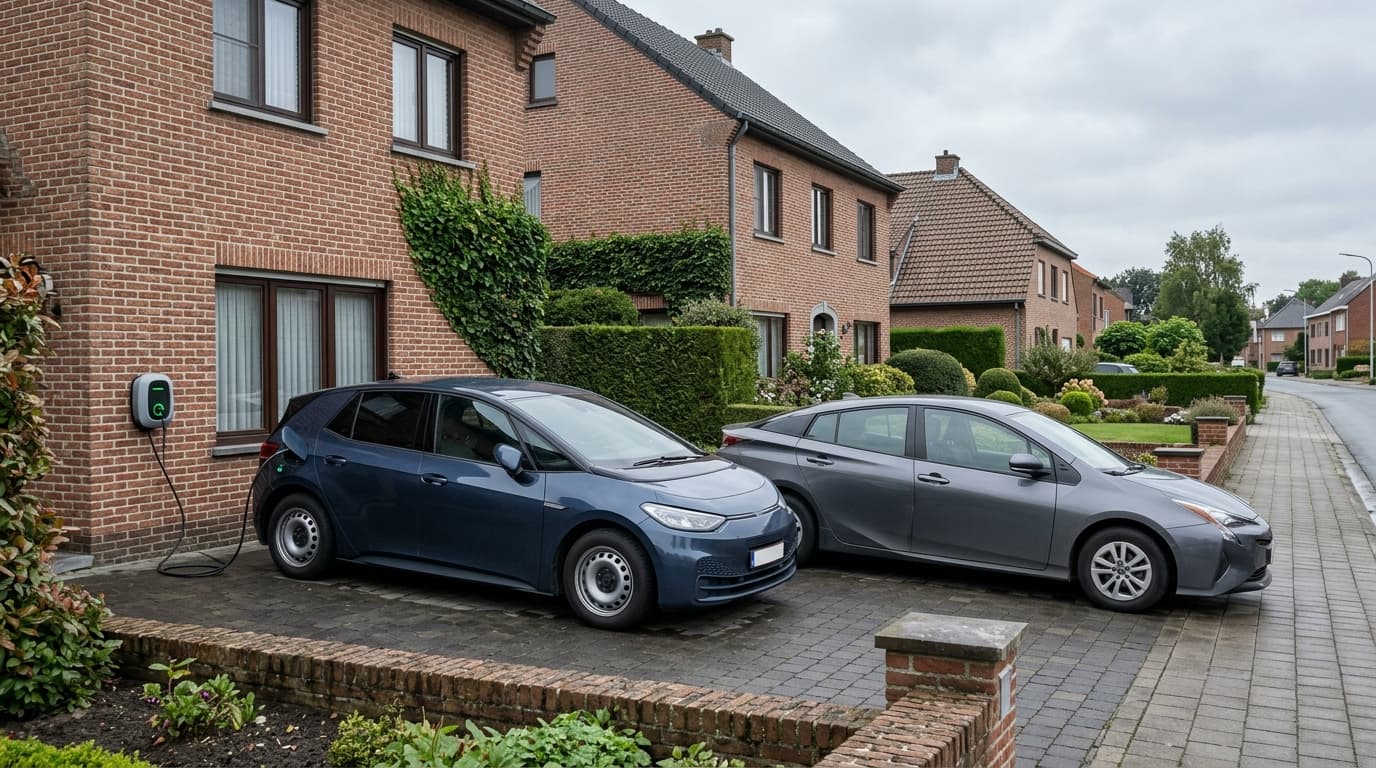
Tesla Model 3 or Volvo EX30: which one for a self-employed person?
The Model 3 if you drive a lot and value range and the charging network; the EX30 if you want the lowest upfront outlay and the lowest benefit-in-kind. Both are credible electric compacts for daily professional use, but they do not target the same buyer.
The Tesla Model 3 keeps two advantages that are hard to match for a high-mileage driver: comfortable real-world motorway range and access to the Supercharger network, still the least painful in Europe when you have to leave your usual route. The Volvo EX30 plays the price and format card: it is a small urban SUV, built in Ghent, whose entry level starts below the Tesla (Moniteur Automobile, 2026). For a self-employed person who drives mainly in town and the suburbs, the EX30 is more than enough and costs less to tie up.
On the Belgian market, the Model 3 starts at around €36,990 for the Standard version, and the Volvo EX30 starts at around €41,730 in Business Edition, with the entry Core version dropping below €37,000 depending on trim (Moniteur Automobile, 2026). What we would avoid: choosing the EX30 "because it's Belgian" if your job means 40,000 km a year. On that profile, the Model 3's range and network pay for themselves in time saved. To place these models in the Belgian electric range, our electric car in Belgium buying guide details range and charging.
What budget should you plan and how much VAT can you reclaim?
Count on €37,000 to €55,000 at the Belgian list price for a credible electric company car, and reclaimable VAT capped at 50% for mixed use. That is the limit over-optimistic calculations forget: electric wins on tax and benefit-in-kind, not on VAT.
The Belgian rule is stable here: as soon as a vehicle is used both professionally and privately, deductible VAT is capped at 50%, on purchase or lease as well as on maintenance and energy (MyFid, 2026). An electric car is no exception to this cap. What changes in its favour is the benefit-in-kind: for a zero-emission car, the CO2 percentage is set at its floor of 4% (LIZY, 2026), producing the lowest taxable benefit on the market — often two to three times lower than that of a combustion car with an equivalent list price. An indexed legal minimum still applies each year.
In practice, this gives an order of magnitude. On an electric car with a €45,000 list price, the annual taxed benefit-in-kind is generally around €1,500 to €2,000, against €3,500 to €5,000 for a comparable combustion car. At your marginal rate, the tax difference on that benefit runs to hundreds of euros a year, every year of ownership. It is an item people underestimate at purchase and that weighs across the whole period.
Should you still consider a plug-in hybrid as a company car in 2026?
For a self-employed individual, yes, marginally: a plug-in hybrid keeps a partial deduction of costs, fossil fuel included. Through a company, no: the tax advantage of plug-in hybrids is fading, while electric keeps its own for longer.
The plug-in hybrid was long the Belgian professional's default compromise. It is no longer the winning calculation through a company: plug-in-hybrid deductibility is declining and will disappear by 2028, when electric stays at 100% for orders placed before 2027. On a car you will keep four or five years, choosing a plug-in hybrid through a company means buying a tax advantage that will have melted away before the contract ends. Add the known technical flaw: with an empty battery, a plug-in hybrid drags its extra weight and uses more than a regular hybrid — a trap for anyone who neglects charging. The detailed figures are in our guide to the taxation of plug-in hybrids in Belgium.
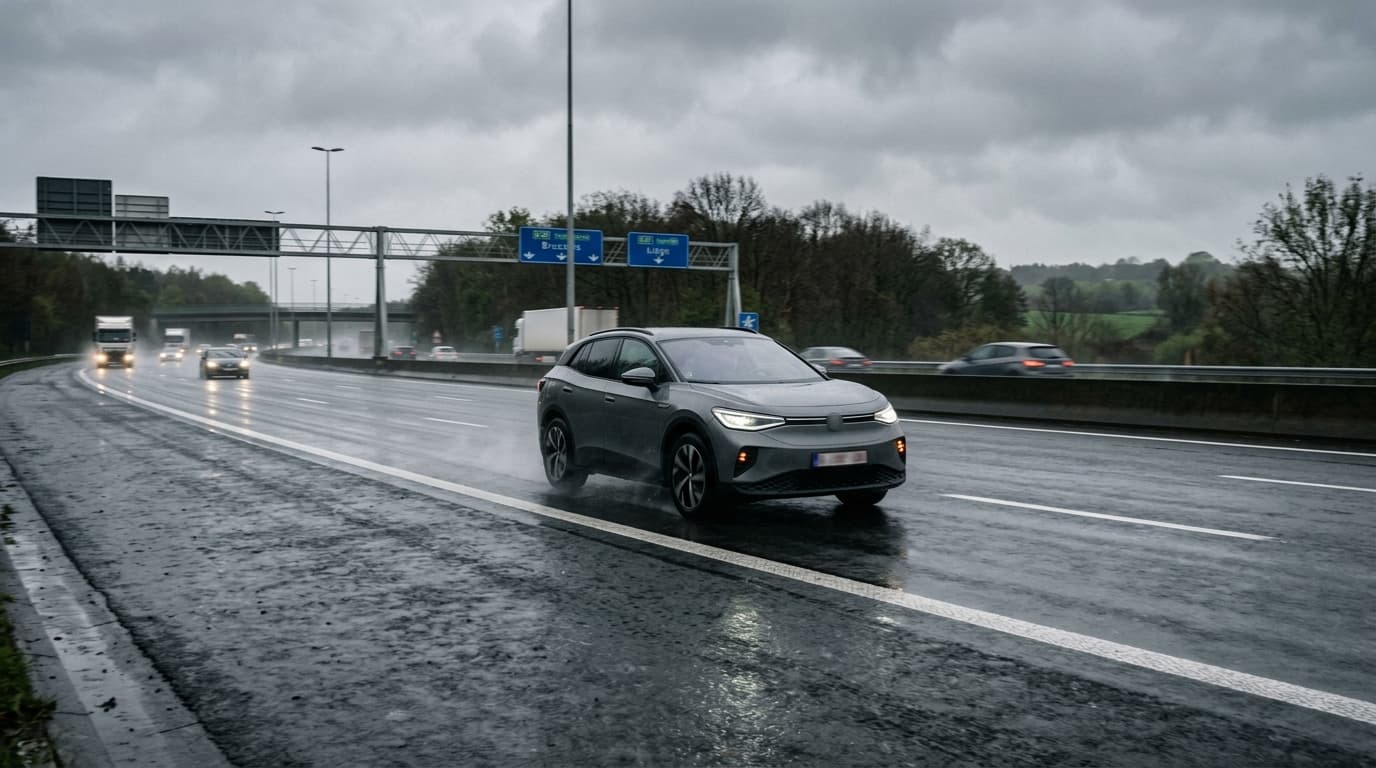
Comparison: 6 company cars for the self-employed in Belgium 2026
| Model | Format | Indicative WLTP range | Indicative BE price | Strength for the self-employed |
|---|---|---|---|---|
| Tesla Model 3 | Saloon | ~430 to 600 km depending on version | From ~€36,990 | Charging network, cost/km |
| Volvo EX30 | Small urban SUV | ~340 to 480 km depending on battery | From ~€37,000 (Core) | Entry price, built in Ghent |
| Renault Mégane E-Tech | Compact | ~300 km real-world on motorway | From ~€35,200 | Upfront outlay, urban format |
| BMW iX1 | Compact SUV | ~430 km | From ~€46,000 | Image, finish, BMW network |
| Škoda Enyaq | Family SUV | ~550 km | From ~€44,000 | 585 L boot, rear comfort |
| Peugeot e-3008 | Family SUV | up to ~700 km (98 kWh) | From ~€48,000 | Range, 520 L boot |
Indicative Belgian list prices as of this article (July 2026), to be checked at the dealership (discounts, stock and versions vary). Price sources: Moniteur Automobile (2026). WLTP ranges are orders of magnitude that vary with trim, battery and real conditions: count on 20 to 25% less at 120 km/h in cold weather. All these models are fully electric, so 100% deductible if ordered before 1 January 2027.
Our verdict
For a self-employed person in Belgium changing car in 2026, the Tesla Model 3 remains the most rational decision: it combines the lowest entry price among credible electric saloons, the best usable range for a high-mileage driver, and a charging network that makes life easier when the job forces unplanned trips. Ordered before the end of 2026, it locks in 100% deductibility and a floor benefit-in-kind for its whole ownership period.
As an alternative, the Volvo EX30 is the best choice for anyone who wants to contain the outlay and benefit-in-kind first: cheaper at entry, built in Ghent, it is enough for urban and suburban use without a second thought. Between the two, the Peugeot e-3008 or the Škoda Enyaq come into their own as soon as you need space for equipment or a family. Whatever the model, the real trade-off comes down to two figures before the badge: your annual professional mileage and whether you have a charger at home. To line up Belgian prices model by model, the comparison tool does the sorting, and the quiz points you to the right fit for your real use.
Comparateur Électriques
Compare tous les électriques côte à côte.
Comparer maintenant →
Frequently asked questions
Julien essaie des voitures depuis 2012, d’abord pour la presse spécialisée belge, aujourd’hui en indépendant depuis Liège. Il croise les données TÜV, ADAC et les prix catalogue belges plutôt que les fiches constructeur. Sa règle : pas d’essai en concession de 20 minutes, pas de verdict sans chiffre vérifiable.