Hybrides
Best car for high-mileage drivers in Belgium
Toyota Corolla, Škoda Octavia, Tesla Model 3 or Renault Mégane E-Tech: which car for 40,000 km a year in Belgium? Real motorway consumption, BE prices and 2026 tax rules.
Past 30,000 km a year, the price on the showroom sticker decides nothing: cost per kilometre does. And on Belgian motorways, the ranking of powertrains isn't the one you read everywhere. We compare five cars sold in Belgium in 2026 — from the Škoda Octavia to the Tesla Model 3 — with Belgian list prices and the real tax picture.
Which car should you choose when you drive 40,000 km a year in Belgium?
It all hinges on one thing: do you have a home charger? If yes, the Tesla Model 3 is the best calculation, with a cost per kilometre no combustion car catches. If no, the Škoda Octavia Combi 2.0 TDI remains the cold answer: roughly 4.5 to 5 l/100 km at 120 km/h, from about €33,880 on the Belgian price list (July 2026).
The charger question is the real tipping point, and it comes before the badge, before the budget, before the styling. With a socket at home, you run on overnight electricity and the kilometre costs a fraction of a diesel's. Without one, you depend on motorway rapid chargers, whose price per kWh wipes out most of the advantage — and you add two stops a week to an already tight schedule.
In practice, that gives four profiles. Home charger and predictable trips: Model 3. No charger, pure motorway, no LEZ on the route: Octavia TDI. Mixed route crossing Brussels or Antwerp: Toyota Corolla Touring Sports hybrid. Home charger but tight budget: Renault Mégane E-Tech. To weigh total cost rather than list price, our comparison of the total real cost of electric versus hybrid puts numbers on the five-year gap.
From how many kilometres a year are you a "high-mileage driver"?
From 30,000 km a year. That is the threshold beyond which cost per kilometre overtakes purchase price in the total calculation, and where every tenth of a litre becomes a visible budget line.
The figure makes sense once you set it against Belgian reality. A Belgian commuter lives on average 18.5 km from work, or 37 km round trip, and half of Belgians stay under 12.5 km (SD Worx, August 2025). Over a working year that comes to roughly 8,000 to 9,000 commuting kilometres. A high-mileage driver at 40,000 km therefore covers four to five times that distance: statistically an outlier, and the buying advice written for the average driver doesn't apply.
The number that really matters: at 40,000 km a year, one tenth of a litre per 100 km is about 40 litres, or close to €100 a year at Belgian fuel prices. A one-litre gap between two powertrains is therefore roughly €1,000 a year, or €5,000 over a typical ownership period. That is more than the price difference between most models in this comparison — and it is why the reasoning inverts compared with a normal buyer.
Does electric hold up for a motorway commuter?
Yes, but on one non-negotiable condition: charging at home. Without a private charger, electric loses most of its economic advantage on this profile, and adds a time constraint that 40,000 km amplifies.
Two realities stack up on the motorway. First, range: at a steady 120 km/h an electric car uses 20 to 25% more than on the combined cycle, because air resistance rises with the square of speed and there is no braking to recover. Real-world range on current models sits between 200 and 400 km depending on the car (La Libre, 2025); on the motorway, count on the bottom of that bracket. Then the price per kWh: at home overnight, the electric kilometre crushes everything; on a rapid charger, it catches up with a frugal petrol.
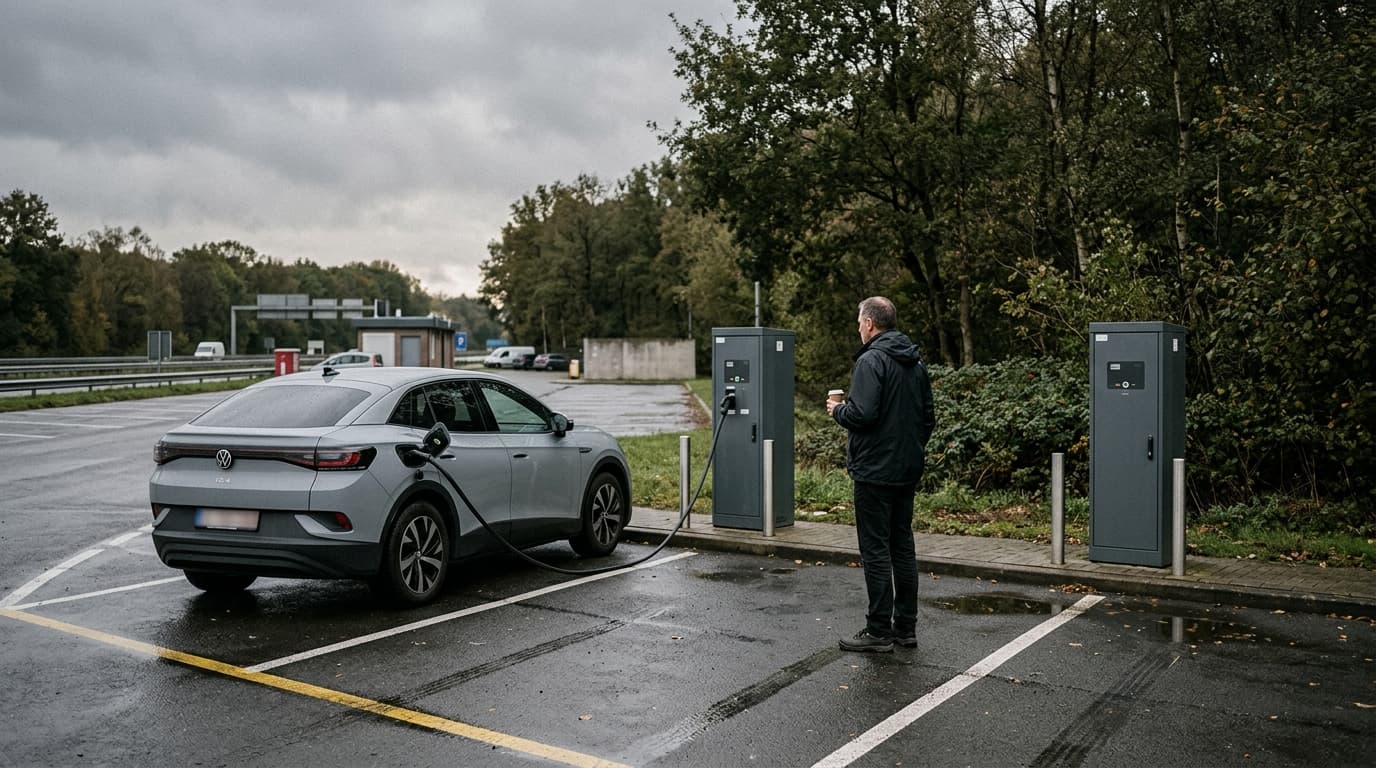
In practice, that gives a calculation of time as much as money. At 40,000 km a year in a Model 3 with a home charger, you only stop on long trips — a few times a month. Without one, you add two 20 to 25 minute sessions a week, around thirty hours a year spent at a motorway service area. What we'd avoid: buying an electric car "in the meantime" while waiting to have a charger installed. Install the charger first.
Toyota Corolla or Škoda Octavia: which one for the motorway?
The Octavia, if your route is more than 80% motorway and crosses no low-emission zone. The Corolla, as soon as the route mixes motorway, main roads and city centres. The two sit within a litre of each other on the motorway, which is not what the brochures promise.
The argument comes down to how the Toyota hybrid produces its savings. The system recovers braking energy and runs electric at low speed: devastating in town, where the Corolla drops below 4.5 l/100 km. At a steady 120 km/h there is nothing to recover and the combustion engine works alone — consumption climbs back to around 5.5 to 6 l. The Octavia 2.0 TDI, meanwhile, is in its element at that speed, around 4.5 to 5 l. The theoretical gap advertised by the combined cycles (4.0 l for the Corolla) doesn't survive the first Namur-Antwerp run.
On the Belgian market, the Corolla Touring Sports 1.8 Hybrid is listed at about €29,990 incl. VAT and the Octavia Combi starts around €33,880 (Moniteur Automobile, 2026). The Octavia gives you a bigger boot and lower motorway consumption; the Corolla gives you an automatic gearbox with no clutch, reliability that is no longer up for debate, and access to Belgian LEZs without a second thought. What we'd avoid: choosing the Corolla "for the fuel economy" if you only drive motorway. You are paying for a hybrid system your route never uses.
Does diesel still make sense for a high-mileage driver in 2026?
Yes, but in an ever-narrower corridor: almost exclusively motorway, no LEZ on the route, and bought privately rather than through a company. Outside that corridor, the answer is no.
Diesel keeps its physical advantage at steady speed: it remains more efficient on the motorway and holds its interest for high-mileage drivers (La Libre, 2025). That is the only argument, and it is a real one. Everything else works against it. The low-emission zones in Brussels, Antwerp and Ghent tighten year after year, and a route that touches any of the three turns the fuel saving into a gamble. Resale value degrades faster than an equivalent hybrid's. And for a self-employed driver, Belgian tax rules push openly towards electric.
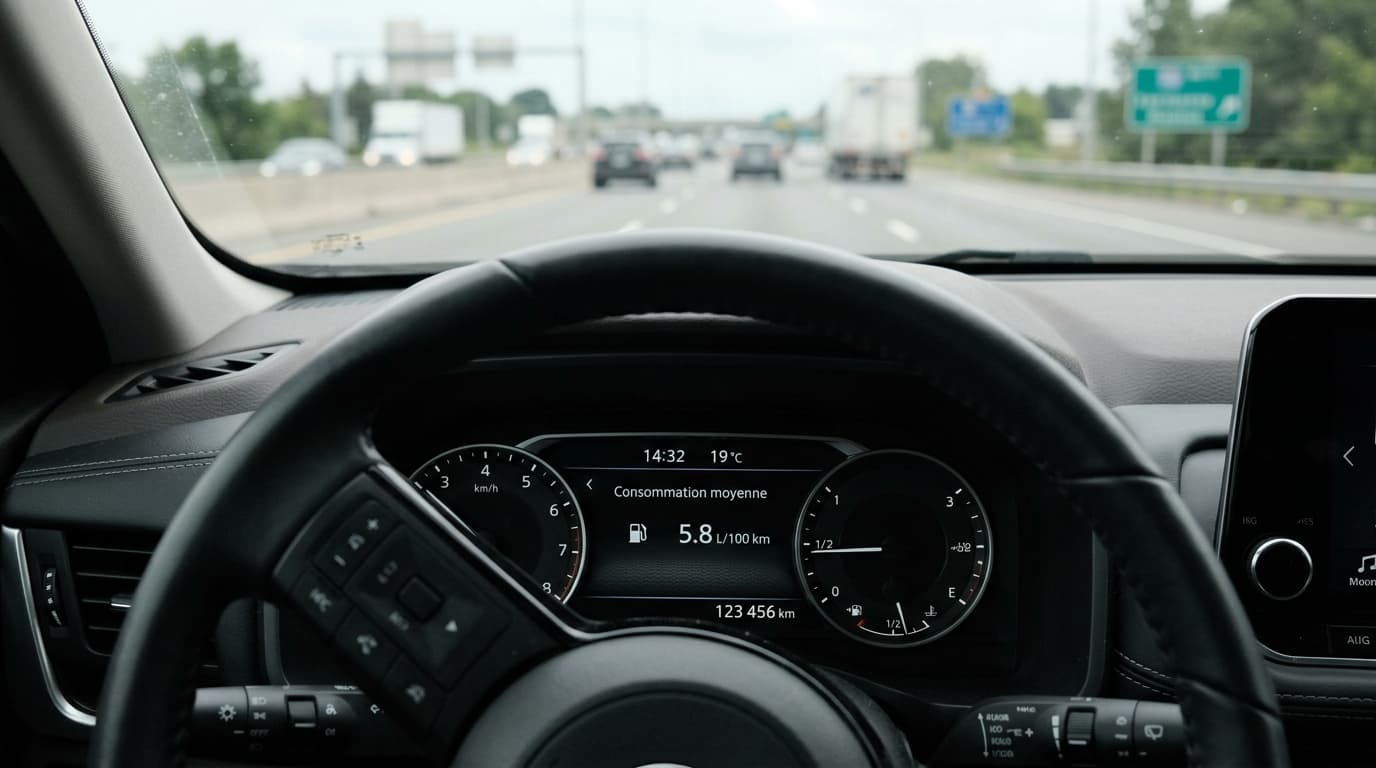
In practice, that draws a clear border. You drive Arlon to Luxembourg every day, privately, never entering a major city: the Octavia TDI is still the best economic decision in this comparison. You drive Louvain-la-Neuve to Brussels: diesel is a five-year trap. What we'd avoid: buying a new diesel in 2026 for a route that touches a LEZ, betting on a future loosening of the rules.
Why is the plug-in hybrid the wrong calculation for a high-mileage driver?
Because on this specific profile it stacks the drawbacks of both worlds: a battery that is empty virtually all the time, around 300 kg of hardware to haul with nothing in return, and a tax advantage that is expiring. It is the least suitable powertrain for long distances — and it is the one most often recommended to commuters.
The PHEV offers 30 to 70 km of electric range (La Libre, 2025). On a 160 km round trip, those 50 km cover less than a third of the journey, and the remaining 110 km are driven carrying the battery's weight. If charging is neglected, the combustion engine takes over and consumption shoots up — the finding is the same across Belgian observers. The PHEV is an excellent choice for someone driving 40 km a day and charging every night. It is the wrong choice for someone driving 160.
The number that really matters, on the company side: PHEV deductibility drops from 75% in 2025 to 50% in 2026 and will disappear in 2028, while electric stays 100% deductible until 2026 before a progressive reduction from 2027 (La Libre, October 2025). On a car kept four or five years, a company high-mileage driver is therefore buying a tax advantage that will have melted away before the contract ends. The full calculation sits in our guide to plug-in hybrid tax in Belgium.
Comparison: 5 cars for high-mileage drivers in Belgium 2026
| Model | Powertrain | Indicative motorway consumption / range | Indicative BE price | Strong point |
|---|---|---|---|---|
| Škoda Octavia Combi 1.5 TSI eTec DSG | Petrol mild-hybrid | ~6 l/100 km | From ~€33,880 | Boot, entry price |
| Toyota Corolla Touring Sports 1.8 Hybrid | Hybrid (HEV) | ~5.5 to 6 l/100 km | ~€29,990 | Reliability, LEZ access |
| Škoda Octavia Combi 2.0 TDI | Diesel | ~4.5 to 5 l/100 km | From ~€33,880 | The most frugal on motorway |
| Renault Mégane E-Tech Electric | Electric (67 kWh usable) | ~300 km real motorway range | From ~€35,200 | Cost/km with a home charger |
| Tesla Model 3 Standard | Electric | ~350 km real motorway range | From ~€36,990 | Charging network, tax treatment |
Indicative Belgian list prices at the date of this article (July 2026), to be checked at the dealer (discounts and stock vary). Price sources: Moniteur Automobile (2026), FEBIAC / Brussels Motor Show for the Model 3 Standard (deliveries from January 2026). Motorway consumption and range figures are orders of magnitude at 120 km/h in mild weather: they vary considerably with weather, load and driving style. The Octavia Combi range spans the whole line-up, from €33,880 to €62,220 depending on trim.
Our verdict
For a Belgian high-mileage driver without a home charger, the Škoda Octavia Combi 2.0 TDI is still the best economic decision in 2026: the most frugal powertrain at 120 km/h, an estate boot that absorbs the job, and a service network everywhere in the country. It is a short-horizon choice, not a ten-year investment — LEZs and resale values will keep hardening against it, and you should buy it knowing that.
As an alternative, and as the default choice as soon as you can have a charger installed, the Tesla Model 3 takes the lead: unbeatable cost per kilometre on overnight charging, 100% deductibility until 2026 for a self-employed driver, and a charging network that remains the least painful in Europe when you leave the usual corridor. Between the two, the Toyota Corolla Touring Sports hybrid is the honest compromise for a mixed route crossing a LEZ: it wins no category, and it loses none either. To place these models in the Belgian hybrid line-up, our hybrid car buying guide for Belgium breaks down the powertrains; the comparison tool lines up Belgian prices model by model, and the quiz points you in the right direction based on your real annual mileage.
Comparateur Hybrides
Compare tous les hybrides côte à côte.
Comparer maintenant →
Frequently asked questions
Julien essaie des voitures depuis 2012, d’abord pour la presse spécialisée belge, aujourd’hui en indépendant depuis Liège. Il croise les données TÜV, ADAC et les prix catalogue belges plutôt que les fiches constructeur. Sa règle : pas d’essai en concession de 20 minutes, pas de verdict sans chiffre vérifiable.