SUV
Dacia Bigster: Belgian prices, trims and real rivals
Dacia Bigster in Belgium: entry price of 24,790 EUR, 3,300 EUR more than an equivalent Duster, a Brussels tax bracket trap, and a head-to-head comparison.
The Dacia Bigster starts at 24,790 EUR in Belgium, but the minimum invoice comes to 25,164 EUR once the delivery pack is added. With identical trim and powertrain, it costs 3,300 EUR more than a Duster. Those 3,300 EUR buy 22.5 centimetres of bodywork, a markedly larger boot, and one extra tax bracket in Brussels.
How much does a Dacia Bigster cost in Belgium?
From 24,790 EUR to 31,190 EUR incl. VAT depending on the version, recommended list prices read on 11 September 2026 on the Dacia Belgium website and valid until 30 September. Five trims make up the Belgian range, with two petrol powertrains and one dual-fuel option.
| Trim | Powertrain | Power | Price incl. VAT |
|---|---|---|---|
| Essential | mild hybrid 140 | 103 kW | 24,790 EUR |
| Expression | mild hybrid-G 140 auto | 103 kW | 28,490 EUR |
| Extreme | mild hybrid 140 | 103 kW | 29,090 EUR |
| Expression | hybrid 155 | 114 kW | 29,490 EUR |
| Journey | hybrid 155 | 114 kW | 31,190 EUR |
Recommended list prices incl. VAT, Dacia Belgium, read on 11 September 2026. Range homologated at 4.6 to 7.4 l/100 km and 104 to 134 g CO2/km under WLTP.
One detail the headline price leaves out. The footnote on the Belgian catalogue explicitly excludes the delivery pack, invoiced at 359 EUR, the 10 EUR vehicle environmental contribution and the 5 EUR battery contribution. Add them up: the cheapest Bigster a Belgian dealer can actually invoice you costs 25,164 EUR, not 24,790 EUR. The 374 EUR gap does not change the nature of the purchase, but it lands on every final quote, and it still catches out plenty of buyers who built their budget to the cent from the offers page.
Between the bottom and the top of the range, expect 6,400 EUR of difference, or 25.8% of the entry price.
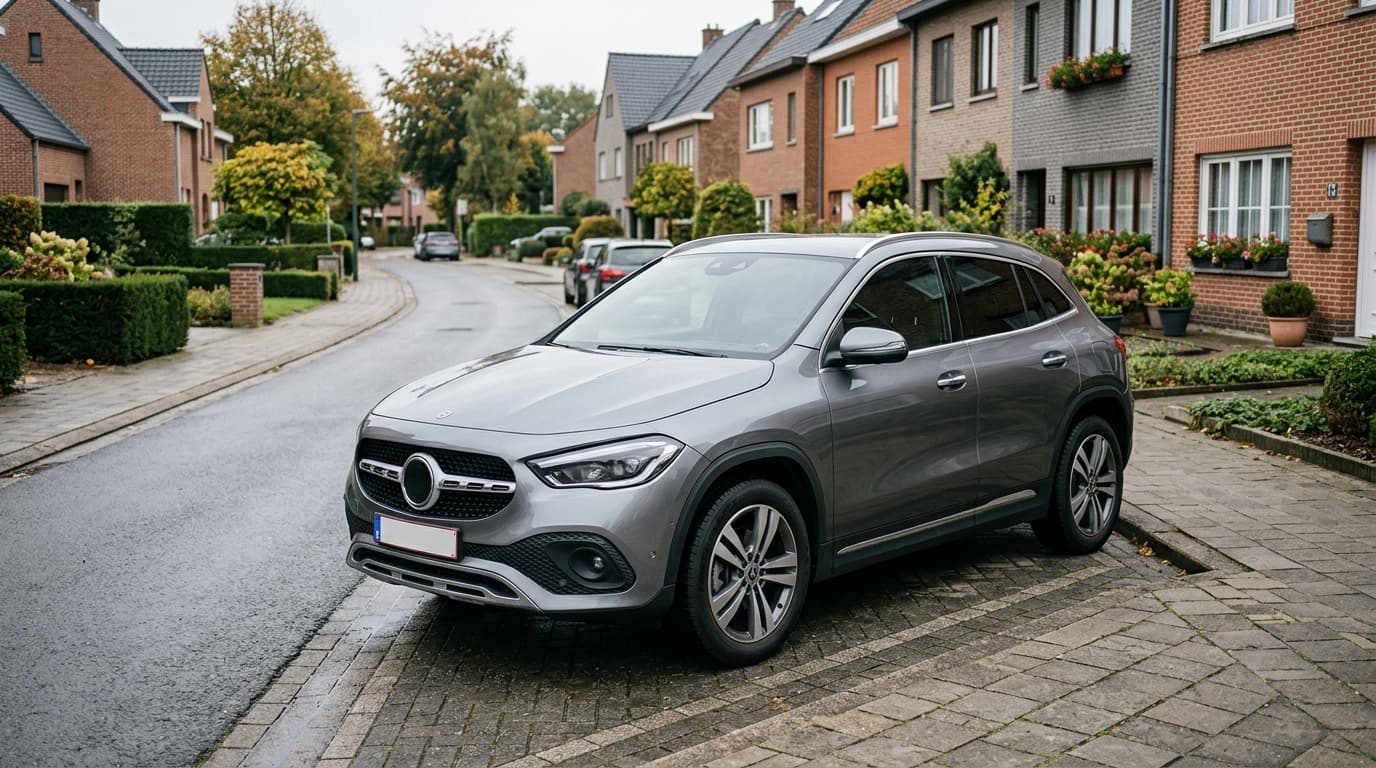
3,300 EUR separate the Bigster from the Duster at identical trim
This is the only honest comparison, because it is the only one where everything else is equal. The Duster Expression hybrid 155 is listed at 26,190 EUR, the Bigster Expression hybrid 155 asks 29,490 EUR. Same trim, same driveline, same dealer, 3,300 EUR apart.
What for? The Bigster measures 4,570 mm against 4,345 mm for the Duster, so 22.5 centimetres more, mostly in wheelbase and rear overhang. Per centimetre, the stretch costs 146.67 EUR. The gain sits in the boot, which Moniteur Automobile describes as the model's genuine advantage over the Duster, and in rear knee room. Width and height, on the other hand, are identical on both cars: nobody gains shoulder room or headroom.
Against an outside rival, the arithmetic flips. The Renault Symbioz full hybrid E-Tech 160 Evolution, which shares most of its hybrid architecture with the Bigster, is listed at 31,000 EUR on the Belgian market for 4,413 mm of length. The Bigster Expression hybrid 155 is therefore 157 mm longer and 1,510 EUR cheaper than its Renault cousin. That is exactly the positioning Dacia is aiming for, and it works.
| Criterion | Dacia Bigster Expression hybrid 155 | Dacia Duster Expression hybrid 155 | Renault Symbioz E-Tech 160 Evolution |
|---|---|---|---|
| Belgian list price | 29,490 EUR | 26,190 EUR | 31,000 EUR |
| Length | 4,570 mm | 4,345 mm | 4,413 mm |
| Power | 114 kW (155 hp) | 114 kW (155 hp) | 118 kW (160 hp) |
| Combined WLTP | 4.6 l/100 km | 4.6 to 7.6 l/100 km (range) | 4.3 l/100 km |
| WLTP CO2 | 104 to 107 g/km | 105 to 140 g/km (range) | 98 to 102 g/km |
Belgian list prices read on 11 September 2026: Dacia Belgium for the Bigster and the Duster, Moniteur Automobile catalogue for the Symbioz. Lengths from manufacturer and JATO data sheets.
Mild hybrid 140 or hybrid 155: which one to pick?
The hybrid 155, unless you drive little and almost always on open roads. And unless you live in Brussels, where the trade-off changes shape entirely.
The 1.8 hybrid behaves like an automatic without a clutch, pulls away on electric power and recovers energy under deceleration, which makes it far more pleasant in town than the mildly electrified three-cylinder. Moniteur Automobile recorded 4.9 l/100 km at a steady pace and 7.5 l/100 km at a brisk pace during its March 2025 first drive, and scored the car 14.90/20 in its full road test in May. On a vehicle close to four metres sixty, those are good numbers.
Three things change with the powertrain you choose:
- The boot: 667 litres quoted for the mild hybrid and the Eco-G, against 596 litres for the hybrid 155, with the battery sitting under the floor (manufacturer data sheet).
- The gearbox: manual on the mild hybrid 140, multimode automatic on the hybrid 155, with nothing in between.
- Taxable power: 103 kW against 114 kW, and those eleven kilowatts cross a bracket boundary.
The tipping point sits in the table above, on the power line. The Extreme mild hybrid 140 costs 29,090 EUR, the Expression hybrid 155 asks 29,490 EUR. Four hundred euros apart on the price list. Except that in Brussels, the first falls into the 101 to 110 kW bracket of the registration tax scale and the second into the 111 to 120 kW bracket, whose base amount is 372 EUR higher. Indexed for the current tax year, that gap approaches 477 EUR. The real Brussels premium for stepping up to the hybrid is therefore not 400 EUR but around 877 EUR, more than double what the price list suggests. Nobody will tell you at the dealership, because the tax arrives one to two months after registration, well after you have signed.
Brussels taxes kilowatts, Flanders taxes carbon dioxide
The Bigster is a textbook case of Belgian tax divergence, and it deserves to be treated region by region before you sign.
In Brussels, the registration tax looks at neither CO2, nor the Euro standard, nor the fuel: it takes power, in fiscal horsepower or in kilowatts, whichever produces the higher amount, then applies an age-based reduction. The direct consequence: the most frugal version in the range is also the most heavily taxed. The 104 to 107 g CO2/km of the hybrid 155 earn it nothing, while its 114 kW cost it a full bracket. Exact amounts can be checked with Brussels Fiscality, which runs MyTax.
In Flanders, the logic reverses. The Flemish BIV is calculated on CO2 emissions, the Euro standard, the fuel and the age of the vehicle, with no power criterion at all. The hybrid 155, at the bottom of the range's emissions band, becomes the cheapest version to register there, while it is the most expensive in Brussels. Same car, two regions, two opposite winners.
Wallonia does both at once. Since 1 July 2025, its formula combines power, CO2, maximum authorised mass and energy type, and no catalogue publishes the result model by model. The Bigster therefore accumulates a power penalty and an emissions advantage on the same version, with the balance depending on its mass. Run the SPW Finances simulator before ordering, because that is the only figure that will bind you. The three mechanisms are covered in detail in our guide to the Belgian registration tax.
One reservation worth flagging, because it applies to what you will read elsewhere too. The reference Belgian catalogue still shows no benefit-in-kind value, no annual road tax and no cost per kilometre for the 2026 Bigster versions: all three fields are empty. A self-employed buyer considering this model as a company car should therefore have the benefit in kind calculated by an accountant rather than trust a figure found online.
Is the Bigster available as a seven-seater?
No. Five seats, and nothing else in the catalogue.
The confusion is understandable: the Bigster is the largest Dacia ever sold, and the brand also markets a seven-seater, the Jogger, advertised from 18,990 EUR. But the Bigster's extra length went into the boot, not into a third row. If you want seven belts from Dacia, it is the Jogger or nothing.
Three Euro NCAP stars, and a poorly protected chest
Euro NCAP published its results in May 2025: three stars, with 69% for adult occupant protection, 85% for children, 60% for pedestrians and cyclists, and 57% for driver assistance systems. On a new car in 2026, that is low.
The detail is more nuanced than the headline score. The passenger compartment stayed stable in the frontal offset test, knee and femur protection was rated good for both front occupants, and the side impacts, both barrier and pole, scored maximum points across every critical body area. The weak spot is the protection of the driver's chest, rated poor, and a set of assistance systems doing the bare minimum. The 85% recorded for child occupant protection, on the other hand, is a good result for a family. Full data sheets are published by Euro NCAP.
Still, three stars are three stars, and a buyer who puts passive safety at the top of the list will look elsewhere. Inside, hard plastics are everywhere, the folding central armrest is replaced by a drop-down backrest that opens a hatch to the boot, and there is no sliding rear bench. Dacia made cost-driven choices and does not hide them.
Our verdict
For a Belgian family that wants space without stepping into the premium segment, the Bigster Expression hybrid 155 at 29,490 EUR is the version to take: the right powertrain, enough equipment, and the best interior space per euro on the Belgian market right now. In Flanders, its tax treatment makes it even more obvious. In Brussels, mentally add 477 EUR of tax before comparing it to the Extreme mild hybrid 140.
As an alternative, the Duster Expression hybrid 155 at 26,190 EUR still makes complete sense if you do not need the extra 22.5 centimetres: same qualities, same engine, 3,300 EUR less. And if the three Euro NCAP stars stop you, our comparison of the best compact SUVs lines up rivals with better safety scores, at a logically higher price. The comparison tool puts them side by side on the criteria that actually decide.
Comparateur SUV
Compare tous les suv côte à côte.
Comparer maintenant →
Frequently asked questions
Julien essaie des voitures depuis 2012, d’abord pour la presse spécialisée belge, aujourd’hui en indépendant depuis Liège. Il croise les données TÜV, ADAC et les prix catalogue belges plutôt que les fiches constructeur. Sa règle : pas d’essai en concession de 20 minutes, pas de verdict sans chiffre vérifiable.