Occasions
Vehicle registration tax: Belgium's three formulas
Brussels taxes power, Flanders taxes emissions, Wallonia multiplies both by weight. Official scales and worked calculations as of 9 September 2026.
The vehicle registration tax is paid once, when the car is registered, and the amount depends first of all on your Region. Brussels taxes engine power, Flanders taxes emissions and the Euro standard, and since July 2025 Wallonia multiplies power by CO2, by weight and by fuel type.
Three administrations, three logics, and one consequence few buyers see coming: two neighbours fifteen kilometres apart on the same road can pay unrelated amounts for the same car. This is not a drafting accident. It is the result of three different political choices, made on three different dates, on a tax inherited from the federal state in 2014.
Three Regions, three ways of counting
Each Region kept the name of the tax and threw away its neighbour's formula. Here is what each one actually measures, as of 9 September 2026.
| Brussels | Wallonia | Flanders | |
|---|---|---|---|
| Basis of the calculation | fiscal horsepower in CV or power in kW, whichever gives the higher amount | base amount in kW, multiplied by CO2, maximum authorised mass and energy | CO2, Euro standard, fuel and age |
| Vehicle weight | not taken into account | yes, divided by 1,838 | no |
| CO2 | not taken into account | yes, divided by 136 under WLTP | yes, core of the formula |
| Depreciation by age | yes | yes | yes |
| Electric car | minimum rate | CO2 factor set to 1, energy coefficient from 0.01 to 0.26 | flat 61.50 € since 01/01/2026 |
| Last overhaul | annual indexation since 2024 | formula fully replaced on 01/07/2025 | environmental formula since 2012 |
Look at the weight line. Only one Belgian scale out of three cares about it, and it is the most recent one. Wallonia explicitly justified its reform by road wear, use of public space and the severity of crashes involving heavy vehicles. Brussels, meanwhile, taxes in 2026 exactly what it taxed in 2001: fiscal horsepower derived from engine displacement.
How is the registration tax calculated in Wallonia?
Since 1 July 2025 Wallonia applies a four-factor multiplication, described on the SPW Finances portal: a base amount drawn from power, multiplied by CO2 over 136, by maximum authorised mass over 1,838, then by an energy coefficient.
The base amount, valid from 1 July 2026 to 30 June 2027, follows seven kilowatt brackets.
| Power | Base amount | Energy coefficient |
|---|---|---|
| 0 to 70 kW | 64.01 € | electric or hydrogen ≤ 120 kW: 0.01 |
| 71 to 85 kW | 128.02 € | electric 121 to 155 kW: 0.10 |
| 86 to 100 kW | 515.20 € | electric 156 to 249 kW: 0.18 |
| 101 to 110 kW | 902.37 € | electric ≥ 250 kW: 0.26 |
| 111 to 120 kW | 1,289.55 € | hybrid: 0.8 |
| 121 to 155 kW | 2,579.10 € | petrol, diesel, LPG, CNG: 1 |
| above 155 kW | 5,159.25 € |
One worked example, which you can repeat on your own certificate. A new petrol hatchback of 96 kW, homologated at 140 g of CO2 under WLTP, with a maximum authorised mass of 1,950 kg: 515.20 × (140/136) × (1,950/1,838) × 1 = 562.67 €. The base amount is then cut by an age coefficient, from 100 % in the first year to 55 % at five years and 30 % at ten years, with a floor of 61.50 €. The same hatchback bought at five years old therefore drops to 309.47 €.
Weight is not a rounding detail in this formula. On a 110 kW vehicle emitting 150 g, raising the maximum authorised mass from 1,900 to 2,200 kg lifts the tax from 1,028.83 € to 1,191.28 €, which is 162.45 € more, or 15.8 %. Three hundred kilos more on the registration document, and nothing else.
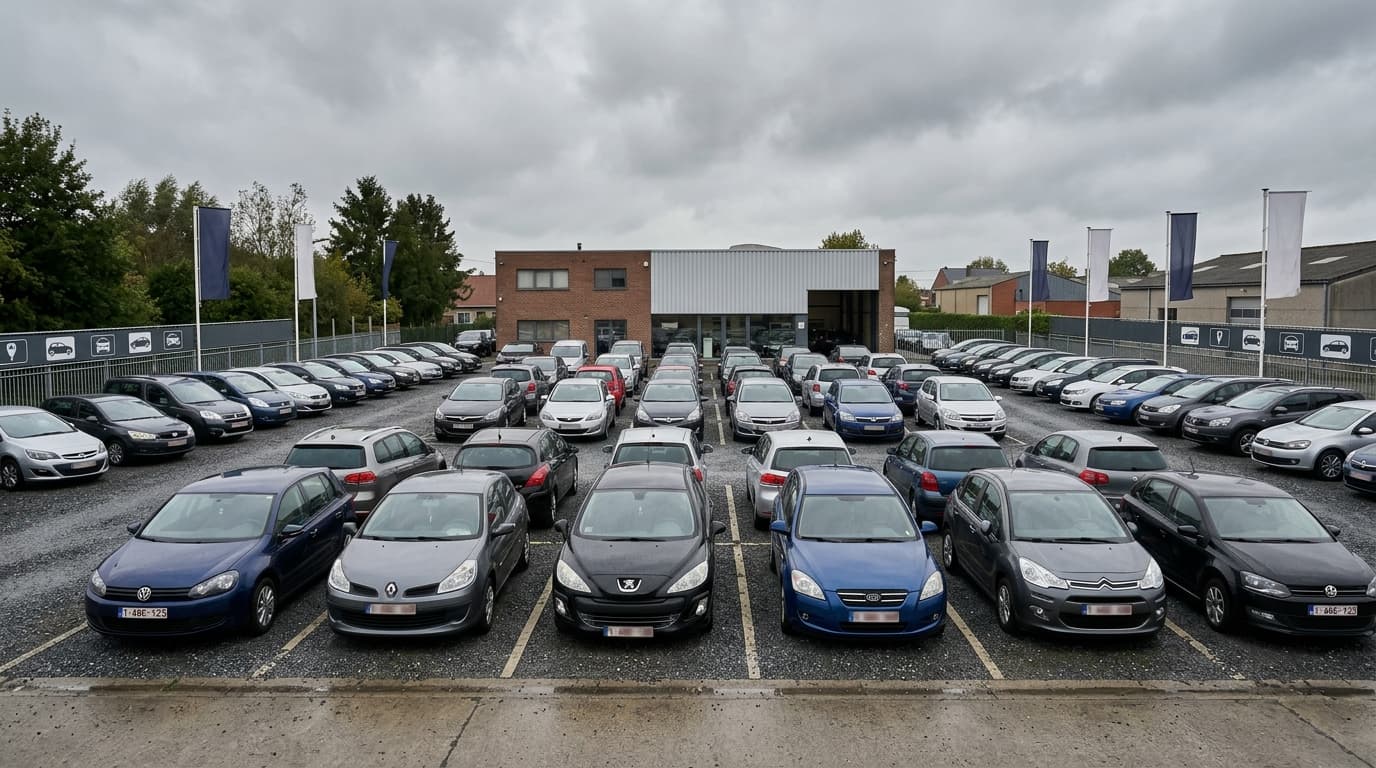
Brussels did not change its formula, it changed its prices
Here is the point online calculators never make, and it comes down to a division.
The base kilowatt scale is historically shared: 61.50 € up to 70 kW, then 123, 495, 867, 1,239, 2,478 and 4,957 €. Wallonia took that grid into its reform and indexed it. Divide the 2026-2027 Walloon amounts bracket by bracket by the original grid: 64.01/61.50, 128.02/123, 515.20/495, and so on up to 5,159.25/4,957. The result is the same seven times out of seven, to four decimal places. 1.0408. The current Walloon scale is the historical scale plus 4.08 %.
Brussels indexes the same original grid, but only since 2024 and while catching up on inflation accumulated since 2019. For private owners the Brussels grid in force from 1 July 2026 to 30 June 2027 runs from 78.88 € to 6,357.85 €. The ratio to the original bounds, 78.88/61.50 and 6,357.85/4,957, gives 1.2826 both times. Brussels therefore applies the historical scale plus 28.26 %, a base amount 23.2 % above the Walloon one at equal power.
The objection is immediate, and it is a fair one: a higher base amount does not mean a higher tax. Wallonia then multiplies by three factors, Brussels stops there. On our new 96 kW petrol hatchback, the final Walloon figure of 562.67 € exceeds the 495 € of the original Brussels bracket, yet stays below the 634.89 € produced by the same bracket indexed at 28.26 %. The gap flips depending on the vehicle, and that is precisely the problem: no simple rule tells you which of the two Regions will cost you less.
Two Brussels details are worth knowing. The indexation does not apply to leasing companies, which stay on the 61.50 to 4,957 € grid for reasons of divided competence. And when power expressed in fiscal horsepower and power expressed in kilowatts fall into different brackets, the higher amount is always the one retained, as the Moniteur Automobile points out. A large but gentle engine can therefore cost more than a small keen one.
How much does an electric car pay in each Region?
The year 2026 ended the idea that electric cars pay nothing.
In Flanders the full exemption disappeared on 1 January: every electric or hydrogen car registered from that date pays a flat 61.50 €, and the annual tax that goes with it runs from 69.72 to 87.24 €. Vehicles registered before 1 January 2026 keep their exemption for as long as they stay with the same holder, as VRT set out when the measure was announced.
In Brussels, electric cars stay at the minimum rate of the grid. Check which minimum applies to your case: the private grid and the leasing grid have not had the same floor since the indexation.
In Wallonia an electric car is not exempt, it is recalculated. The CO2 factor is set to 1 instead of the usual ratio, and the energy coefficient falls to 0.01 below 120 kW. An electric city car therefore lands on the 50 € floor. But that coefficient climbs in steps with power, and this is where the bill changes nature: an electric SUV of 250 kW with a maximum authorised mass of 2,800 kg pays 5,159.25 × 1 × (2,800/1,838) × 0.26, which is 2,043.49 €. For a vehicle with no tailpipe emissions that would pay 61.50 € in Flanders. The ratio is above 33.
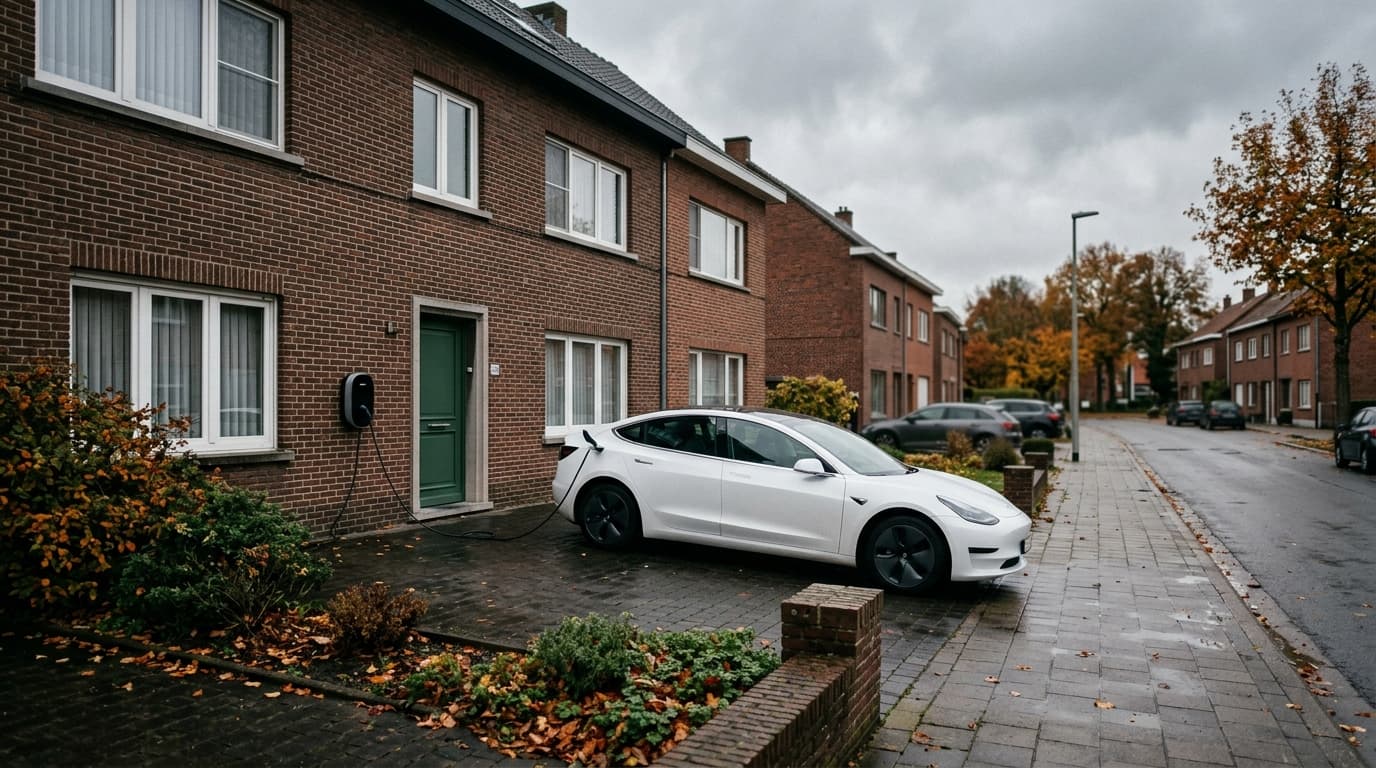
The kilowatt that costs 423 euros
The seven power brackets create steps, and some of them are vertiginous.
Going from 85 to 86 kW multiplies the base amount by 4.0244. In both Regions, since they share the same original grid. On our petrol hatchback of 140 g and 1,950 kg, the Walloon tax rises from 139.82 € to 562.67 € for one extra kilowatt, which is 422.85 € more. In Brussels the same step is worth 372 € on the original grid.
The other thresholds worth checking before signing an order form:
- 70 to 71 kW: the base amount doubles, from 64.01 to 128.02 € in Wallonia.
- 85 to 86 kW: multiplication by 4.02, the harshest step in the scale.
- 100 to 101 kW: plus 387.17 € in Wallonia, plus 372 € on the original Brussels grid.
- 120 to 121 kW: another doubling, from 1,289.55 to 2,579.10 €.
- 155 to 156 kW: a further doubling, this time worth 2,580.15 € in absolute terms.
Two trim levels of the same model, a few kilowatts apart, can therefore open a tax gap wider than their difference in list price. The mid-range engine, the one brochures present as the sensible compromise, is sometimes the most expensive one to register.
What about the annual road tax?
Two taxes, two rhythms, two formulas.
The registration tax is one-off and is triggered by a change of holder. The road tax comes back every year for as long as the plate lives. In Brussels and Wallonia that annual tax ignores CO2 and weight: it rests on fiscal horsepower alone, from 107.18 € for four horsepower or fewer up to 2,741.77 € at twenty horsepower, with 149.56 € per additional horsepower beyond that. In Flanders it follows the same environmental logic as the registration tax.
A Walloon can therefore pay dearly at registration because of weight, then little each year because the displacement is small. Neither predicts the other.
Our verdict
Before buying, run the calculation in your own Region, on the exact version you are targeting, with box P2 of the technical sheet in front of you. All three administrations publish an official simulator, and only that simulator binds anyone. Two reflexes pay off: check whether the engine you want crosses a power threshold, and look at the maximum authorised mass if you live in Wallonia.
On a used car, depreciation works in your favour, but it applies only to the Walloon base amount, not to the CO2, weight and energy factors that multiply it afterwards. A heavy five-year-old vehicle is still a heavy vehicle in the eyes of the scale. Our guide to reliable used cars covers the checks that come before registration, and our article on the technical inspection before a sale covers the costs that land at the same moment.
On an electric car, the tax advantage still exists, but it has moved down the range. Below 120 kW, Wallonia charges the floor. Above 250 kW it charges more than a comparable diesel in some configurations. The regional incentives still belong in the overall calculation, and our comparison tool helps put several versions side by side before deciding.
Sources: SPW Finances, registration tax amounts, scale valid from 01/07/2026 to 30/06/2027 · SPW Finances, car tax reform of 1 July 2025 · Moniteur Automobile, registration tax in Brussels and Wallonia · VRT NWS, end of the Flemish exemption for electric cars (9 October 2025) · FLEET, indexation of Brussels car taxes. Scales collected on 9 September 2026. The example amounts are calculations applied to the vehicle profiles described in the text, not readings taken from specific models. Only your own regional simulator is authoritative.
Comparateur Occasions
Compare tous les occasions côte à côte.
Comparer maintenant →
Frequently asked questions
Julien essaie des voitures depuis 2012, d’abord pour la presse spécialisée belge, aujourd’hui en indépendant depuis Liège. Il croise les données TÜV, ADAC et les prix catalogue belges plutôt que les fiches constructeur. Sa règle : pas d’essai en concession de 20 minutes, pas de verdict sans chiffre vérifiable.