Occasions
kW to hp: converting, and which power gets taxed
1 kW is 1.36 hp. But Belgian registration tax reads kW, Wallonia's annual tax reads engine size, the brochure reads hp. Belgian scales as of 29 Sept 2026.
To go from kilowatts to horsepower, multiply by 1.36: 100 kW is 136 hp. But a Belgian car carries three powers that do not convert into one another: the kW on the registration certificate, the hp in the brochure and the fiscal horsepower, derived from engine size. Only the first conversion is mechanical. The taxes pick their own unit.
The power of an engine measures the energy it delivers per second. The watt is the legal unit, the horsepower is its historical heir, and Belgian taxation still clings to that heritage.
How do you convert kW to hp, and hp to kW?
A metric horsepower (ch in French, PS in German) is exactly 735.49875 watts, about 0.7355 kW, according to Wikipedia. Two factors are enough: kW × 1.3596 gives hp, and hp × 0.7355 gives kW.
| Power in kW | Equivalent in hp | Brochure figure |
|---|---|---|
| 55 | 74.8 | 75 hp |
| 66 | 89.7 | 90 hp |
| 85 | 115.6 | 116 hp |
| 96 | 130.5 | 130 or 131 hp |
| 100 | 136.0 | 136 hp |
| 110 | 149.6 | 150 hp |
| 150 | 203.9 | 204 hp |
Conversions recalculated on 29 September 2026 with the factor 1.35962. Manufacturers round to the unit.
One trap, though: the Anglo-Saxon horsepower, the HP, is 745.7 W rather than 735.5 W. A kilowatt is therefore 1.341 HP, not 1.360 hp, a 1.4% gap that can be enough to shift by one notch a power sitting right on a tax threshold when you read a spec sheet from the United Kingdom.
The kWh has nothing to do with it: it is the battery's energy, not the motor's power.
A Belgian car shows three powers, and only one converts
The Belgian registration certificate carries engine size in box P.1, power in kilowatts in box P.2 and fiscal horsepower in box P.6. The brochure announces horsepower. Three figures, three uses.
| Power | Unit | Where to read it | Which tax reads it |
|---|---|---|---|
| Engine power | kW | Box P.2 | Registration tax, Wallonia and Brussels |
| Commercial power | hp (ch) | Brochure, manufacturer's site | None |
| Fiscal power | CV fiscaux | Box P.6, derived from engine size P.1 | Annual road tax, Wallonia and Brussels |
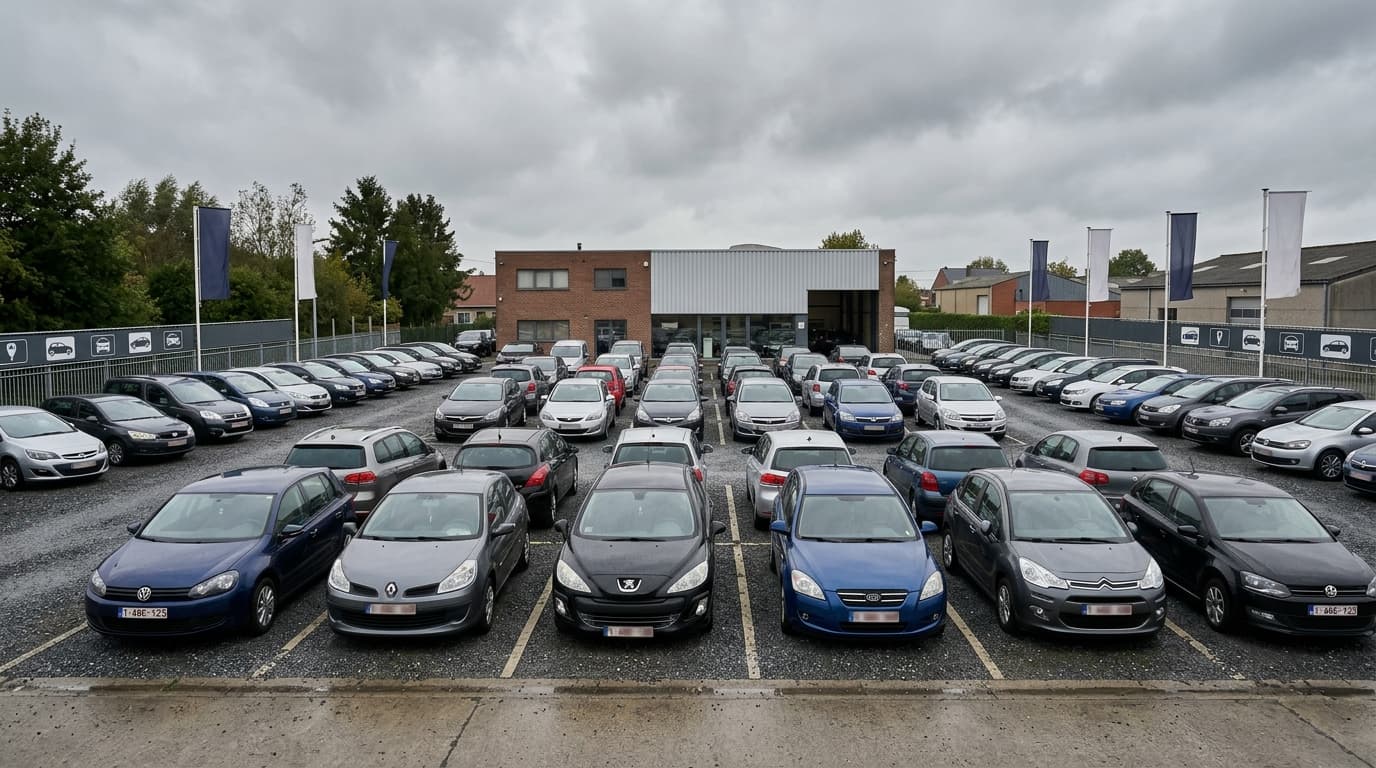
The power you compare at the moment of purchase, the brochure's, is the only one of the three that no Belgian administration reads. That is the thesis of this article, and it is more concrete than it sounds: two 150 hp cars can fall in the same kilowatt band and in two fiscal-horsepower bands €250 apart every year.
Between 116 and 117 hp, the tax base is multiplied by four
Wallonia's registration tax starts from a base amount set per band of kilowatts, then multiplies it by CO2, mass and an energy coefficient. Here are the seven bands of the scale valid until 30 June 2027, translated into horsepower.
| Band (kW) | Band ceiling in hp | Walloon base amount | Step to the next band |
|---|---|---|---|
| 0 to 70 | 95.2 | €64.01 | × 2.00 |
| 71 to 85 | 115.6 | €128.02 | × 4.02 |
| 86 to 100 | 136.0 | €515.20 | × 1.75 |
| 101 to 110 | 149.6 | €902.37 | × 1.43 |
| 111 to 120 | 163.2 | €1,289.55 | × 2.00 |
| 121 to 155 | 210.7 | €2,579.10 | × 2.00 |
| over 155 | no ceiling | €5,159.25 | not applicable |
Base amounts from SPW Finances, valid from 01/07/2026 to 30/06/2027, read on 9 September 2026. Ceilings in hp recalculated on 29 September 2026.
The certificate rounds to the whole kilowatt. A car advertised at 116 hp reads 85 kW there (85.3), and a car advertised at 117 hp reads 86 kW (86.05). One horsepower of difference in the brochure, and the base amount goes from €128.02 to €515.20, that is €387.18 more before any multiplier.
It happens again. From 100 to 101 kW, that is from 136 to 137 hp, the base gains another €387.17. From 110 to 111 kW, between 150 and 151 hp, it gains €387.18. Three identical steps in a row, at the round figures brochures use most.
After multiplication, the real gap varies with CO2 and mass. On the 140 g, 1,950 kg petrol compact from our registration tax article, going from 85 to 86 kW moves the Walloon tax from €139.82 to €562.67, that is €422.85 for one horsepower.
How many fiscal horsepower is 150 hp?
No number, because there is no relationship. In Wallonia and Brussels, fiscal horsepower is read from a table of engine sizes, not from the engine's power.
| Engine advertised at 150 hp | Typical engine size | CV fiscaux | Walloon annual tax |
|---|---|---|---|
| Electric (110 kW) | not applicable | 4 | €107.18 |
| 1.5 turbo petrol | 1,498 cm³ | 8 | €313.24 |
| 2.0 diesel | 1,968 cm³ | 11 | €561.00 |
SPW Finances scale from 01/07/2026 to 30/06/2027, additional decimes included, read on 17 September 2026. Typical engine sizes for these engine families, not readings on specific models.
Between petrol and diesel the gap is €247.76 a year and €1,238.80 over five years, on a frozen scale. Against the electric car it rises to €453.82 a year. The three cars have the same brochure power.
The table holds another surprise, detailed in our complete Walloon road tax scale: one cubic centimetre too many, from 1,950 to 1,951 cm³, adds €128.70 a year.
The French pages that answer "150 chevaux en chevaux fiscaux" do not transpose here. In France, fiscal horsepower is calculated from kilowatts and, before November 2019, from CO2. In Belgium, Wallonia and Brussels read engine size.
Should you then ignore the hp in the brochure?
No. To compare the character of two models, horsepower remains the unit everyone shares, and a buyer relying on the kW of box P.2 alone will not be able to say whether a car is lively or not.
The nuance lies in taxation, and it is harsher on hybrids. Brussels and Wallonia tax the power of the combustion engine alone, the one in box P.2, not the combined power announced in the brochure, as SPW Finances writes and as Moniteur Automobile recalled on 1 March 2026.
Example: the Toyota Yaris hybrid announces 116 or 130 hp combined, about 85 and 96 kW. Its combustion engine develops only 68. Both versions fall in the first band, at a €64.01 base, whereas 96 kW would have placed it at €515.20, 8.05 times more. Our Yaris hybrid review details the calculation down to the €50 floor.
On an electric car it is the opposite: the motor's power counts, and a lot. Wallonia's energy coefficient is 0.01 up to 120 kW, then climbs in steps to reach 0.26 from 250 kW, close to 340 hp. On a pure petrol car, brochure and box P.2 coincide, and the conversion is enough.
Brussels, Wallonia, Flanders: which one reads which power?
None reads the same one. The same certificate, presented in Namur, Ixelles or Ghent, does not produce the same bill.
- In Wallonia, the registration tax starts from the kW of box P.2, and the annual tax from fiscal horsepower derived from engine size.
- In Brussels, the registration tax uses the higher of fiscal power in CV and power in kW, and the annual tax follows fiscal horsepower. The Brussels annual scale has not been read horsepower by horsepower on an official source: no amount is therefore given here.
- In Flanders, neither kW nor fiscal horsepower underpins the tax, which rests on CO2, Euro standard, fuel and age. The Vlaams Belastingportaal publishes the official simulator.
The figure to note before you sign
To compare several versions side by side, the comparison tool shows the power of the models it lists.
Sources: Wikipedia, cheval-vapeur (735.49875 W; mechanical HP 745.706 W) · SPW Finances, registration tax, scale from 01/07/2026 to 30/06/2027 · SPW Finances, annual road tax amounts, scale from 01/07/2026 to 30/06/2027 · Moniteur Automobile, registration tax Brussels and Wallonia · Vlaams Belastingportaal. Scales read on 9 and 17 September 2026, conversions recalculated on 29 September 2026. The engines cited as examples are generic profiles, not readings on specific models. Only your regional administration's simulator is authoritative.
Comparateur Occasions
Compare tous les occasions côte à côte.
Comparer maintenant →
Frequently asked questions
Julien essaie des voitures depuis 2012, d’abord pour la presse spécialisée belge, aujourd’hui en indépendant depuis Liège. Il croise les données TÜV, ADAC et les prix catalogue belges plutôt que les fiches constructeur. Sa règle : pas d’essai en concession de 20 minutes, pas de verdict sans chiffre vérifiable.