Citadines
Winter tyres in Belgium: the law, the price, the chains
Winter tyres are not compulsory anywhere in Belgium. Prices recorded on 18 September 2026, the hidden €183 annual changeover bill, and the three neighbours that do not joke about it.
No Belgian law requires winter tyres. Not on 1 November, not when it snows, not on the high ground of the Ardennes. The question still deserves to be asked differently, because the bill that really decides it is not the one from the tyre shop.
It comes from the workshop, and it repeats every year.
Are winter tyres compulsory in Belgium?
No, and there is no territorial or weather-based exception.
The requirement was considered, then dropped. Today winter tyres are simply allowed all year round, on one condition almost nobody knows about: their speed rating must not be lower than the one specified by the manufacturer. Fit a tyre rated H (210 km/h) to a car homologated in V (240 km/h) and you switch regime: that tyre is then tolerated only from 1 October to 30 April, and a legible sticker showing the maximum speed must sit in your field of vision. It costs a few euros in any accessory shop, and it is missing from almost every car concerned.
The Belgian country sheet from Touring, updated on 16 September 2025, adds a point the French pages ignore: Belgian rules only require identical tyres on the same axle. Two winter tyres are therefore legal. They are also a very bad idea, and the FAQ at the bottom of this page explains why.
Studded tyres are banned, article 81.4.4
They are banned across the whole country, with no authorised season.
The Highway Code reserves to the transport minister the power to allow them exceptionally, when conditions justify it. Which is to say never. Pages explaining how to choose studded tyres are written for Scandinavian or Austrian readers, not for you.
Winter or all-season tyres for a Belgian winter?
The Belgian climate leans fairly clearly towards all-season, provided you look at the right marking.
Two symbols share the sidewall. M+S is purely declarative: the manufacturer stamps it on, without any test. 3PMSF, the small three-peak mountain with a snowflake, is earned after a standardised snow grip test. A 3PMSF all-season tyre is legally the equal of a winter tyre in the countries that require one.
Across the handful of days of settled snow the Belgian lowlands get, the performance gap between a 3PMSF all-season and a proper winter tyre stays theoretical. It becomes real above 500 metres, on the eastern plateaus, and on the day you drive to the Alps.
Then there is wear, which nobody talks about. A winter tyre fitted from October to April wears for six months a year, not twelve. Two sets therefore last roughly twice as long in calendar years. Rubber is not the problem.
€199 of tyres, €183 of labour every year
Here is the number that really counts, and it is written nowhere on a tyre.
On 18 September 2026 we recorded the Auto5 summer / winter changeover package for 10 to 16 inch sizes: €22.90 per tyre, thirty minutes of work, including removing the tyre from the rim, a new valve and balancing. Four tyres, twice a year, comes to €183.20 of annual labour. The site was running a 50 % promotion on the service that day, excluded from the figures below.
| Item, recorded on 18/09/2026 | Unit price | For four wheels | Frequency |
|---|---|---|---|
| Winter tyre 3PMSF 205/55 R16, entry level (CentralePneus) | €49.68 | €198.72 | every 4 to 6 winters |
| Winter tyre 3PMSF 205/55 R16, mid range (CentralePneus) | €69.79 | €279.16 | every 4 to 6 winters |
| All-season tyre 3PMSF 205/55 R16 (CentralePneus) | €72.59 | €290.36 | every 3 to 4 years |
| Seasonal changeover 10 to 16 inch (Auto5, package F0467) | €22.90 | €91.60 | twice a year |
Prices including VAT, recorded on the official product pages of both retailers on 18 September 2026, excluding delivery and excluding the running promotion. Service lives are practical orders of magnitude, not manufacturer warranties.
The arithmetic that follows is brutal. Over five winters, the changeovers cost €916, which is 4.6 times the price of the winter tyre set itself. And the 3PMSF all-season set, although it costs €91.64 more to buy than the entry-level winter set, repays that gap within half a season of avoided changeovers.
One honest caveat, because it flips the verdict for some readers: if your second set sits on its own rims, the workshop swaps complete wheels instead of breaking tyres off rims, and the annual bill collapses. You then have to buy four steel rims, which pays for itself around the fourth year. Storing the removed wheels is billed separately.
Snow socks or chains, and at what price?
For a Clio IV, sixteen compatible references sat in the Auto5 catalogue on 18 September 2026, between €39.90 for a pair of Access+ M snow socks and €354.99 for a pair of König K-Summit K22 chains. A ratio of 8.9 for an object used on the same day, on the same road.
That ratio does not measure performance. It measures clearance: the dearest references are the front-mounted and composite chains designed for so-called non-chainable cars, whose wheel arches leave no room for a conventional chain. You are paying for your suspension geometry, not for grip.
Points to check before paying:
- Exact compatibility with your tyre size, not with your car model. A Clio in 195/65 R15 and a Clio in 205/45 R17 do not take the same ones.
- The words "suitable for non-chainable vehicles" in the product sheet, which multiply the price by three or four.
- The tensioning type, manual or automatic. Automatic costs around €40 more and goes on with frozen fingers without swearing.
- How long snow socks survive on dry tarmac, counted in kilometres rather than seasons.
- Weight and bulk, if you travel five-up with skis on board.
How do you fit chains without getting it wrong?
Fifteen minutes the first time, four after that. The classic mistake happens at step 5.
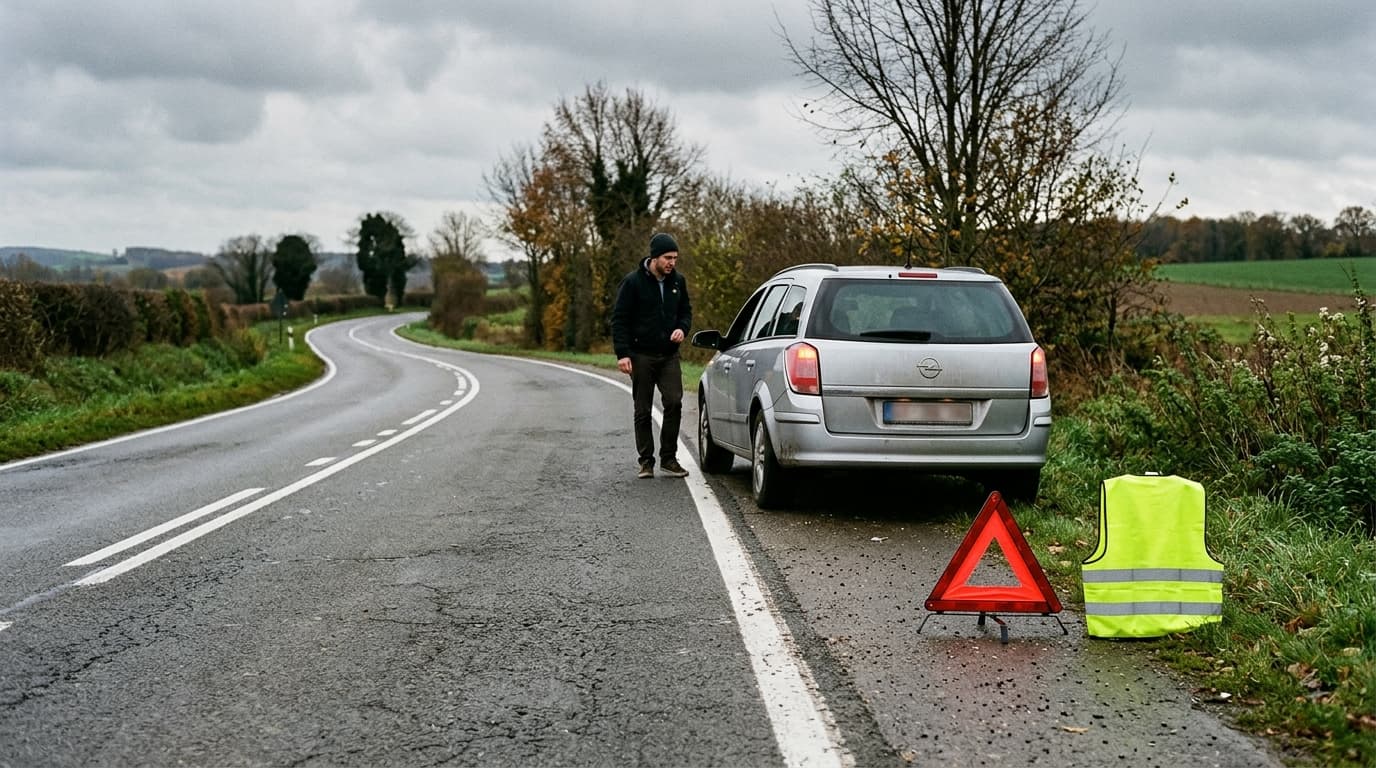
- Stop somewhere safe, off the carriageway, engine off and handbrake on. High-visibility vest before stepping out, as our article on mandatory car equipment in Belgium explains.
- Identify the driven wheels. Front-wheel drive: at the front. Rear-wheel drive: at the back. If in doubt, the service booklet says so on page one.
- Untangle the chain flat on the ground before taking it near the wheel. A twisted chain always jams in the same place, behind the disc.
- Pass the hoop behind the tyre and close it at the top, with the running section centred on the tread.
- Tension it, then drive twenty metres and tension again. This is the step skipped nine times out of ten, and it is the one that stops a slack chain from whipping the wheel arch and cutting a hose.
- Stay below 50 km/h and take the chains off as soon as the road is clear.
In Belgium, chains may only be used when there is snow or ice, and no specific speed limit attaches to them. Spike-spiders fall under the same regime.
What do you need to cross Germany or France?
Your Belgian car falls under the rules of the country you enter the moment you cross the border, and those rules have tightened recently.
| Country | Rule in force | Accepted marking |
|---|---|---|
| Belgium | no requirement | not applicable |
| Germany | situational requirement, no fixed dates, as soon as the road is wintry | 3PMSF only since 01/10/2024 |
| France | mountain law, 1 November to 31 March, in designated municipalities | 3PMSF only since 01/11/2024 |
| Luxembourg | requirement by conditions (ice, packed snow, slush, frost) | M+S or 3PMSF, €74 fine |
| Netherlands | no requirement | not applicable |
Table compiled on 18 September 2026 for a Belgian-registered vehicle, from the country sheets of Touring and of the ACL Luxembourg.
The German switch of 1 October 2024 turned thousands of perfectly legal M+S tyres into tyres with no winter value east of the border, overnight. Luxembourg did not follow: article 160 of its Grand-Ducal decree of 23 November 1955 still accepts M+S on its own, while forbidding any mix of different tyre types on the same car. Three borders, three logics.
Our verdict: 3PMSF all-season, with two exceptions
The main recommendation. A set of four all-season tyres marked 3PMSF, fitted year round. They keep you legal in Germany and France, they save you €183.20 of annual changeovers, and across a Belgian lowland winter their theoretical handicap almost never shows up.
The alternative. A second winter set on steel rims, if you live above 500 metres, if you cover more than 25,000 km a year, or if you drive to the Alps every season. The rims pay for themselves around the fourth year.
The case for buying nothing. One ski week a year, a car that sleeps in the garage through the two annual snow episodes: a pair of €40 snow socks in the boot is enough, and costs less than the gap between two tyre ranges.
Before ordering anything, take a depth gauge or a two-euro coin: below 4 mm of tread, the winter versus all-season debate is moot and the tyres need replacing first. The subject connects to our piece on the most reliable city car and to our guide on the technical inspection before selling, where tread depth is one of the checked items. To compare models before deciding, the comparison tool filters by price, boot space and fuel consumption.
The references quoted in the table remain available at Auto5 and at CentralePneus. We have not tested any of these products: the specifications and prices come from the official product pages of both retailers, recorded on 18 September 2026.
Sources: Touring, Belgian country sheet updated 16/09/2025; Belgian Highway Code, art. 81.4.4; ACL Luxembourg, 19/09/2024 amended 25/11/2024; prices recorded on Auto5.be and CentralePneus.be on 18/09/2026.
Comparateur Citadines
Compare tous les citadines côte à côte.
Comparer maintenant →
Frequently asked questions
Julien essaie des voitures depuis 2012, d’abord pour la presse spécialisée belge, aujourd’hui en indépendant depuis Liège. Il croise les données TÜV, ADAC et les prix catalogue belges plutôt que les fiches constructeur. Sa règle : pas d’essai en concession de 20 minutes, pas de verdict sans chiffre vérifiable.