Citadines
Mandatory Car Equipment in Belgium: the 4 Items
Fire extinguisher, warning triangle, first aid kit, hi-vis vest: the four items every Belgian-registered car must carry, with retail prices recorded on 24 August 2026.
Four items, and a single text imposing them. Every car registered in Belgium must carry a one-kilo fire extinguisher, a warning triangle, a first aid kit and a reflective vest. We recorded retail prices on 24 August 2026 to find out what compliance actually costs.
Short answer: 51.26 €. Plus one line on the receipt almost nobody sees coming.
Four items, one royal decree from 1968
The list fits in a sentence and has not moved in years: extinguisher, triangle, first aid kit, vest.
The legal basis is the Royal Decree of 15 March 1968 on the technical regulation of vehicles. Article 70 covers the extinguisher, article 71 the first aid box. The triangle and the vest fall under the rules on signalling an immobilised vehicle. The Federal Police lists all four in its road safety reminders, and Moniteur Automobile repeats them identically in its 6 July 2023 briefing.
One detail decides everything else, and it is widely misunderstood: these obligations follow the country of registration, not the country you happen to be driving through. A Clio registered in Lille crosses Belgium without an extinguisher, perfectly legally. The same Clio registered in Liège must carry one all the way to Marseille. The same logic applies to imported company cars and to used vehicles bought in the Netherlands or Germany, which almost always arrive without an extinguisher because their home country never required one.
Is the extinguisher mandatory in Belgium but not in France?
Yes, and that is the main source of confusion on this subject.
Google records around 480 monthly searches in France for « extincteur voiture obligatoire », and 70 for « extincteur voiture obligatoire dans quel pays ». In Belgium the same query peaks at 30 a month. The gap tells the whole story: demand for content comes from a country where the item is not mandatory, so the French answers ranking at the top are simply wrong for a Belgian driver.
The difference is not trivial. Belgium belongs to the small European group that requires an extinguisher in passenger cars, alongside Greece, Bulgaria, Romania, Poland and Lithuania. France, Germany, the Netherlands and Spain stop at the triangle and the vest, when they require anything at all.
On Belgian soil the extinguisher must meet three cumulative conditions: at least one kilo of capacity, a label conforming to the Belgian standard, and a valid expiry date. The third one is where it goes wrong.
Three extinguishers on one shelf, two years of validity apart
We recorded the product pages of Brico.be and Gamma.be on 24 August 2026. Same format, same dominant brand, and yet differences that never jump out in store.
| Product recorded on 24/08/2026 | Retailer | Fire classes | Label | Price |
|---|---|---|---|---|
| Carpoint 1 kg extinguisher | Gamma.be | B and C | Belgian standard, recent validity | 19.99 € |
| Carpoint 2026 1 kg extinguisher | Brico.be | B and C | Belgian standard BE 2026 | 22.99 € |
| Belmic 1 kg extinguisher | Gamma.be | A, B and C | Belgian standard | 23.49 € |
| 1 kg powder extinguisher | Gamma.be | multi-purpose powder | BENOR 2028 | 24.49 € |
| Warning triangle, fixed mount | Gamma.be | not applicable | compliant | 12.99 € |
| Carpoint 41-piece first aid kit | Brico.be | not applicable | car contents | 12.99 € |
| Carpoint Oxford yellow vest, XL | Brico.be | not applicable | EN ISO 20471 | 5.29 € |
Prices including VAT, taken from the official product pages of both retailers on 24 August 2026, excluding delivery and in-store promotions.
Two lessons come out of this table, and neither is the expected one.
The first is worth 1.50 €. That is the gap between the extinguisher labelled 2026 sold at Brico for 22.99 € and the one labelled 2028 sold at Gamma for 24.49 €. Buying the former in August 2026 means buying an item whose label expires within months, so scheduling a second full purchase inside two years. Measured per year of validity gained, that 1.50 € is probably the best spend in the whole car accessories aisle, and it hinges on a line printed in small type on the cylinder.
The second comes down to a single letter. The Carpoint units at 19.99 € and 22.99 € cover classes B and C, meaning flammable liquids and gases. Not class A, the one covering solids: seats, mats, trim, dashboard plastics. The Belmic at 23.49 € covers all three. Fifty cents more than the B/C unit at Brico for an extra fire class, on an item you keep for five years, is not a long debate.
Should the vest stay on board or only be worn?
Both, and Belgian sources contradict each other on this point.
Montgomery Local Police states in writing that the vest is "not mandatory" on board, while also recalling the obligation to wear it when leaving the vehicle where stopping is prohibited. Belgian insurers and car retailers, on the other hand, present on-board presence as an obligation since 2009. The contradiction is real, and it explains why the question keeps circling back on forums.
The practical outcome is simple, though, because both readings converge on the same gesture. You must wear the vest when stepping out on a motorway or an expressway. You can only wear it if it is in the cabin. A vest stored in the boot forces you onto the hard shoulder to retrieve it, exposing you precisely where the text is trying to protect you. The legal debate loses all interest the moment you reduce it to that mechanic.
A vest costs 5.29 €. You need one per occupant, not one per car, if the rule is to be worth anything on the day it matters.
The triangle, the kit and four storage mistakes
Neither of these two items expires or needs servicing, yet they are the ones most often found wanting during a check. Not because they are missing: because they are badly stored or incomplete.
Points worth checking once a year, boot open, in five minutes:
- The extinguisher date, readable on the label or the gauge. Expired means non-compliant, even if the cylinder is full.
- The extinguisher mounting, inside the cabin and firmly held. An extinguisher rolling under the seats becomes a 1.7 kg projectile in a crash.
- The kit contents, whose plasters, compresses and gloves oxidise or dry out. Kits sold in Belgium generally follow the German DIN 13164 standard, the sector's de facto reference.
- The triangle and its stand, unfolded once to check the hinges still hold. A triangle that refuses to stand up on a motorway signals nothing at all.
- The vest in the cabin, never in the boot.
The triangle goes 30 metres behind the car on an ordinary road, and 100 metres on a motorway. Those distances are not decorative: they match the reaction distance of a driver travelling at the speed allowed on each type of road.
What happens if one of the four is missing?
Two separate consequences, and the costlier one is not the fine.
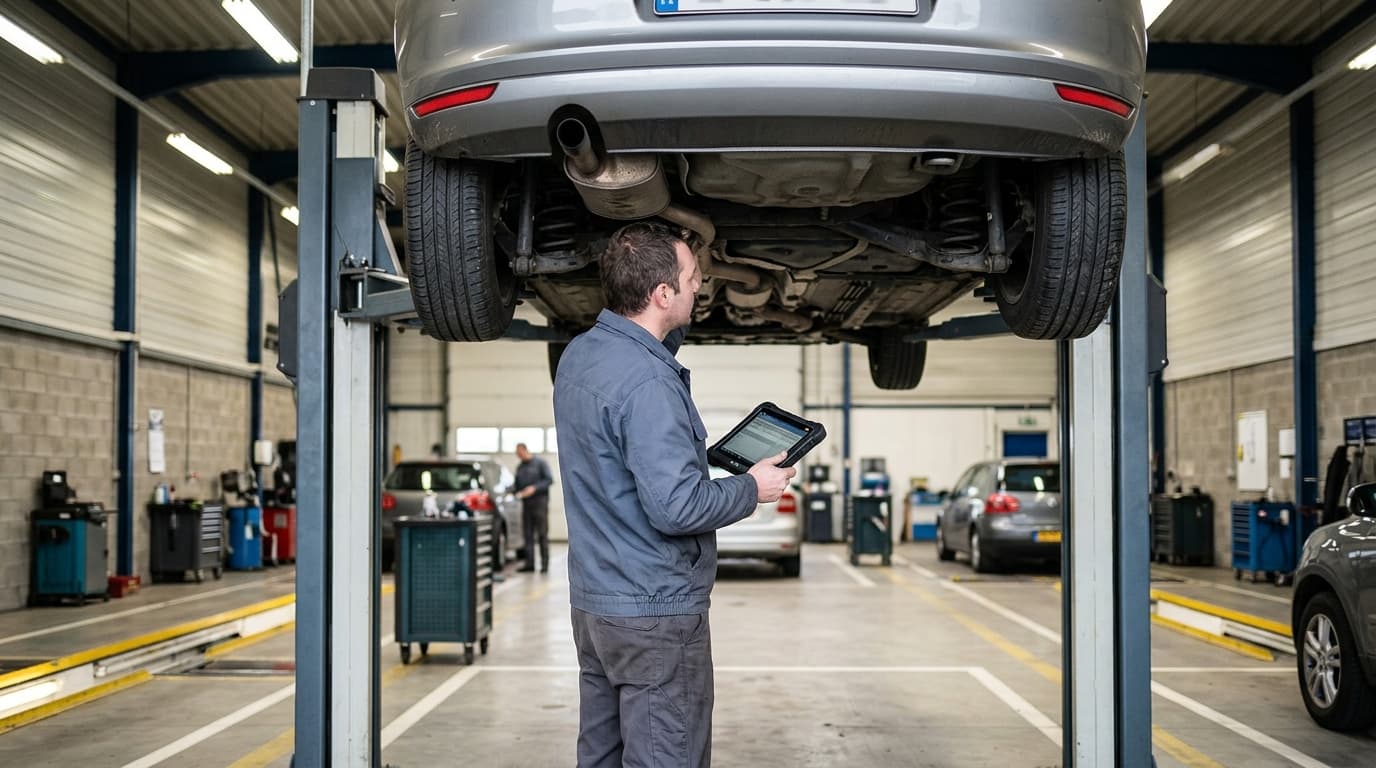
At the roadworthiness test, the presence of the extinguisher and its expiry date are among the points checked. An expired or absent cylinder earns you a remark and, depending on the centre, a return visit. The real cost is not the extinguisher but the journey, the queue and the second appointment, on a slot you had already blocked out. Readers who buy used know the story: the car clears every mechanical check and stumbles on a twenty-euro object.
During a roadside check, a missing mandatory item falls under immediate collection. Amounts vary with the qualification applied and the region where the offence is recorded, which makes any promise of an exact figure reckless: ask your police zone or your insurer rather than trusting a number copied from a French forum.
Then there is the scenario that actually justifies these four items, and it has nothing to do with paperwork. An engine bay fire is decided in the first thirty seconds. Beyond that, a one-kilo extinguisher is useless and the only reasonable response is to move away from the car.
Crossing France, Germany or Luxembourg changes the kit
Your Belgian car remains subject to Belgian rules everywhere. But the country you cross may add its own requirements, and those are not in the 1968 decree.
| Country crossed | Add to your Belgian kit | Worth knowing |
|---|---|---|
| France | Crit'Air sticker for low emission zones | Extinguisher and kit not required there, but keep yours |
| Germany | Umweltplakette for the Umweltzonen | The kit should in principle meet DIN 13164 |
| Luxembourg | Nothing specific | Vest and triangle required, as at home |
| Netherlands | Nothing specific | No safety equipment imposed on Dutch vehicles |
Table compiled on 24 August 2026 for a Belgian-registered vehicle. Low emission zone rules change fast: check your destination municipality before leaving.
The French and German stickers are ordered online through each country's official portal, for a few euros. Intermediary resellers charge three to five times the price for the same document, adding nothing to the service.
Our verdict: 51 € once, 5 € a year afterwards
Entry budget. 51.26 € for all four items at the lowest prices recorded on 24 August 2026. Add 3.50 € if you take the ABC extinguisher over the B/C, which we recommend.
Recurring budget. The extinguisher is the only consumable on the list. Over a five-year validity, a 24.49 € unit works out below 5 € a year. The triangle, the kit and the vest are replaced when they break, not on a fixed date.
The habit to build. Buy the extinguisher with the furthest expiry printed on it, even at 1.50 € more, and note the date in your calendar the day you buy it. It is the only one of these four items that becomes non-compliant on its own, without anything breaking.
When to buy nothing. A car bought new from a Belgian dealer almost always leaves the showroom with all four items. Open the boot and the cabin before ordering anything: the duplicate costs more than the oversight.
Buying used? The subject connects directly to our reliable used car checklist for Belgium and our file on the diesel particulate filter at the roadworthiness test, the other item that fails perfectly healthy cars. To compare models before deciding, the comparison tool filters by price, boot space and consumption.
Both product pages quoted in the table remain available at Brico and at Gamma. We tested none of these products: the specifications and prices quoted come from the official pages of both retailers, recorded on 24 August 2026.
Sources: Royal Decree of 15 March 1968 (art. 70 and 71), Belgian Federal Police, Montgomery Local Police, Moniteur Automobile (06/07/2023). Search volumes: Google Ads Keyword Planner, Belgium and France, recorded on 24 August 2026. Prices including VAT recorded on Brico.be and Gamma.be on 24 August 2026.
Comparateur Citadines
Compare tous les citadines côte à côte.
Comparer maintenant →
Frequently asked questions
Julien essaie des voitures depuis 2012, d’abord pour la presse spécialisée belge, aujourd’hui en indépendant depuis Liège. Il croise les données TÜV, ADAC et les prix catalogue belges plutôt que les fiches constructeur. Sa règle : pas d’essai en concession de 20 minutes, pas de verdict sans chiffre vérifiable.