SUV
Best SUV for a Large Family in Belgium
Kodiaq, Peugeot 5008, Dacia Jogger or Hyundai Santa Fe: which SUV for a large family of 2-3 kids in Belgium? BE 2026 prices, boot space, safety and verdict.
A large family looks first for space, safety and a running cost that holds up over years of school runs and holidays. The question isn't "which SUV is biggest" but "which one suits two or three children without blowing the budget". We compare four models sold in Belgium in 2026 — from the Škoda Kodiaq to the Dacia Jogger — with Belgian prices, real boot space and a clear verdict.
Which SUV should you choose for a large family in 2026?
For most Belgian families with two or three children, the Škoda Kodiaq is the most rational SUV: large boot, three ISOFIX anchors, proven reliability and a contained price versus premium rivals. The Peugeot 5008 follows closely, the only one in the group with three genuine individual rear seats.
The Kodiaq favours usable space over styling. Its boot tops 900 litres in five-seat layout, and its bench takes three child seats without a permanent game of Tetris. The 5008 answers with a three-seat individual second row, a rare asset for fitting three baby seats side by side. Behind this pair, the Hyundai Santa Fe moves up in class and price, while the Dacia Jogger plays another card: seven seats at rock-bottom cost, but a raised estate rather than a true SUV.
In practice, that gives four profiles. You want the best space-price-reliability compromise: the Kodiaq. You need to fit three child seats side by side: the 5008. You want the lowest price: the Jogger, or the Dacia Bigster as a five-seater. You want well-finished premium: the Santa Fe. To place these models in the wider Belgian range, our ranking of the best SUVs in Belgium broadens the picture.
Do you really need 7 seats for a large family?
No, unless you regularly carry more than five people. For two adults and two or three children, a roomy five-seater is more practical day to day, less bulky and cheaper than a seven-seater whose third row stays folded 90% of the time.
The rule is simple: seven seats help if you often carry grandparents, school car-pooling, or if your three children need three child seats side by side that a standard bench can't take. Otherwise, the third row mostly eats into the boot and the budget. On the Belgian market, a well-finished true seven-seater starts around €42,000 to €50,000, whereas a roomy five-seater like the Dacia Bigster drops below €25,000.
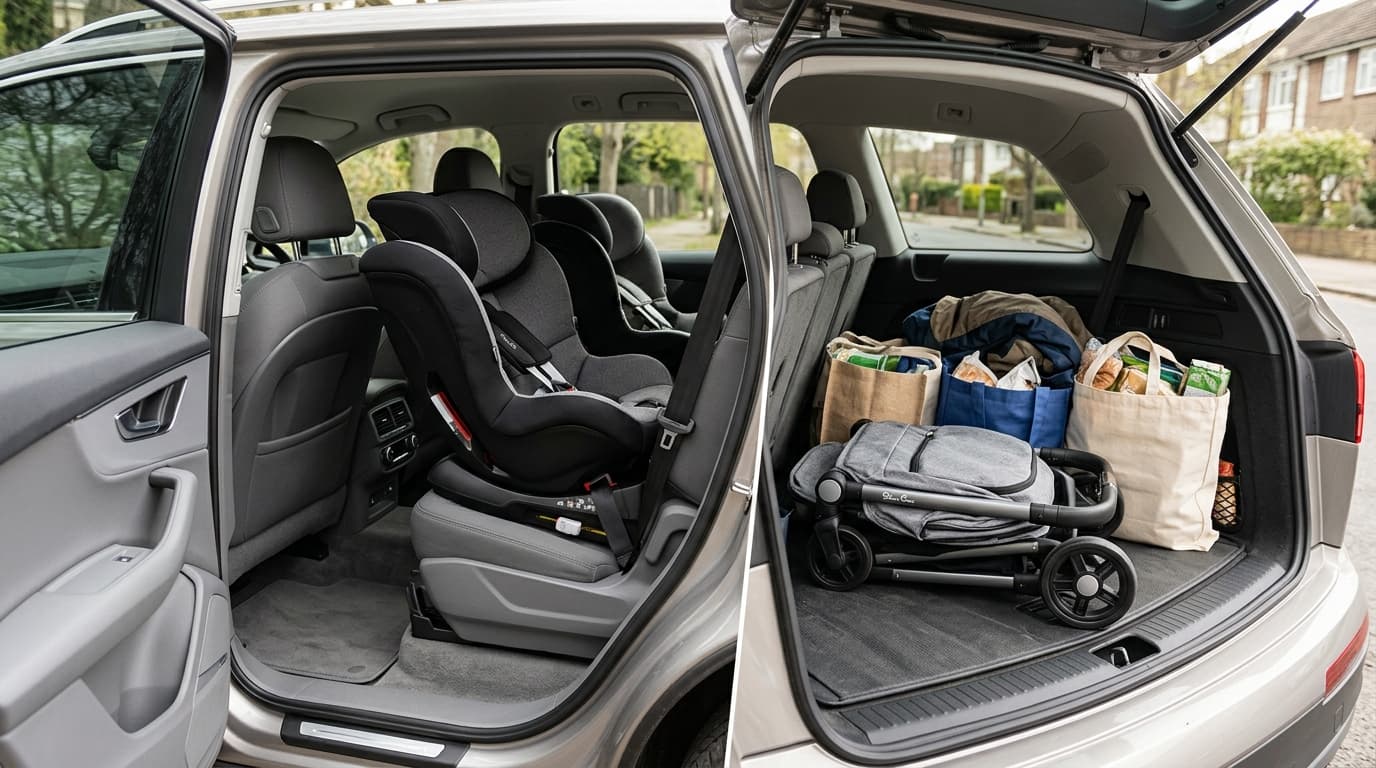
The number that really matters: boot volume in the layout you use every day, not the seats-folded maximum. A Kodiaq keeps over 900 litres in five-seat form; a seven-seater often drops to 150-350 litres once the last row is up. If you really carry seven people regularly, our 7-seat SUV comparison 2026 covers that specific need.
Is the Škoda Kodiaq the best family SUV?
For versatile family use, yes: the Kodiaq combines one of the segment's biggest boots, three ISOFIX anchors and proven Volkswagen Group mechanicals. It's the SUV that asks the fewest compromises for a family of two or three children.
The Kodiaq was designed around interior space. Its boot reaches over 900 litres in five-seat layout, its bench slides to trade legroom for luggage, and the plain finish stays well assembled in Škoda's pragmatic logic. The 2026 range covers mild-hybrid petrol, diesel and the plug-in hybrid iV for drivers watching company-car tax. It comes in five or seven seats, leaving the choice without switching cars.
On the Belgian market, the Kodiaq starts around €47,900 on the price list as a 150 hp MHEV, with the plug-in hybrid iV above (Škoda Belgium, July 2026). Its latest generation scores five stars in Euro NCAP crash tests. In practice, that gives a simple line of reasoning: if you want the most versatile family SUV without overthinking, the Kodiaq is the safe bet. What we'd avoid: loading it with premium options that push it past €60,000, where a well-equipped 5008 hybrid delivers very similar family service for less.
Peugeot 5008: the right choice for three children in the back?
Yes, if you need to fit three child seats side by side. The 5008 is one of the few SUVs to offer three genuine individual rear seats, each wide enough for a baby seat or booster, where most benches only take two comfortably.
The 5008 has a second argument: it covers hybrid, plug-in hybrid and full electric on the same body, with seven seats as standard. The 145 hp hybrid starts around €42,200, the 225 hp PHEV around €45,190, and the electric e-5008 around €46,690 in Allure trim, with up to 502 km WLTP range (manufacturer pricing and data, July 2026). Its driver aids include a 360° camera and adaptive cruise control, handy for loaded family use.
In practice, that gives a clear boundary. Three child seats side by side, no home charger: the 145 hp hybrid. Daily charging or a company car: the e-5008, whose 2026 tax deductibility changes the maths for a self-employed driver. Mind the third row: as on its rivals, it suits children on short trips. To settle the technology question, our electric vs hybrid: real total cost puts the Belgian numbers side by side.
Which family SUV for a small budget?
Under €26,000, two Dacias dominate: the Bigster as a roomy five-seater (667-litre boot, from ~€24,122 incl. VAT) and the Jogger as a seven-seater (from ~€21,490 as a TCe 110 hp). No other maker offers this much family space at that price in 2026.
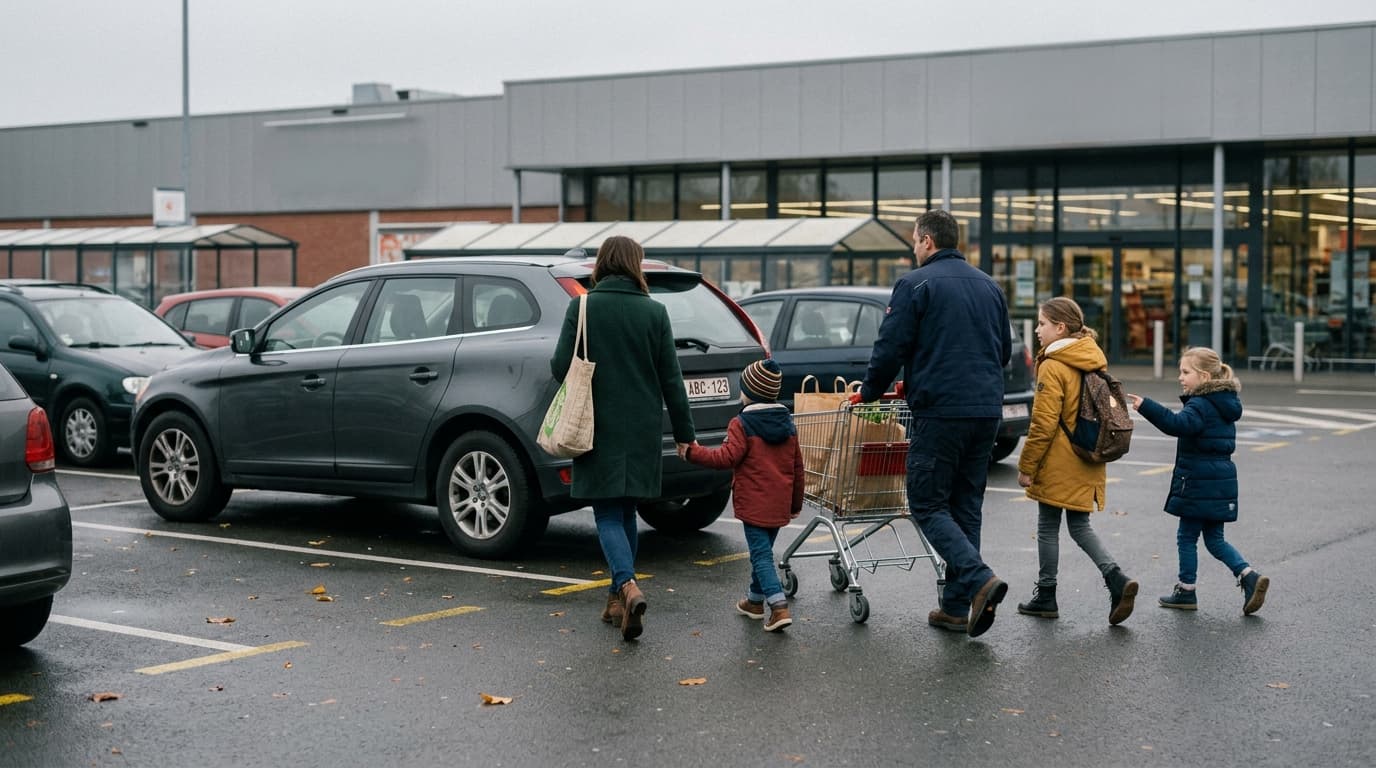
The Bigster targets families who want space without paying the premium: 667 litres of boot in five-seat form, a 4.57 m length and an entry price around €24,122 incl. VAT (July 2026). The Jogger remains the only genuinely affordable seven-seater, from around €21,490 as a TCe 110 hp or €25,990 as a more comfortable, automatic Hybrid 140 hp. It's not a true SUV but a raised estate derived from the Sandero. To step up slightly in finish, the Škoda Karoq with its sliding VarioFlex bench (boot up to 521 litres, from ~€28,500) or the Renault Austral E-Tech hybrid (527 litres, from ~€34,900) remain credible five-seaters.
In practice, that gives three recommendations by budget ceiling. Rock-bottom five-seater: Bigster. Rock-bottom seven-seater: Jogger. A notch up in finish: Karoq. What we'd avoid: paying €50,000 for a premium SUV used 100% for town and school runs, where a Bigster does the same family job. If used cars interest you, our guide to a reliable used SUV under €20,000 prices the good deals.
Hyundai Santa Fe: premium family car, worth the price?
It's worth it if you want the top of the family segment and keep your car a long time. The Santa Fe bets on a spacious cabin, careful finish and a frugal hybrid drivetrain, around €50,000 on the Belgian 2026 price list.
Deeply restyled, the Santa Fe plays the space card: its boxy shape frees up generous room and a large boot, with a decent third row for a seven-seater. Its hybrid drivetrain runs around 6 to 7 real litres in mixed family use, and its latest generation scores five Euro NCAP stars. Its cousin the Kia Sorento, technically close, adds a 7-year manufacturer warranty, a strong argument for anyone keeping their car ten years.
In practice, that gives this: the Santa Fe makes sense if interior volume, finish and standout design matter more than price. It costs clearly more than an equivalent Kodiaq or 5008 hybrid, and that premium buys comfort and image, not superior mechanicals. For rational family use, the Kodiaq stays more relevant on the average Belgian budget.
Comparison: 6 family SUVs in Belgium 2026
| Model | Seats | Boot (5-seat) | 2026 powertrains | Indicative BE price |
|---|---|---|---|---|
| Dacia Bigster | 5 | 667 L | Petrol, hybrid | From ~€24,122 |
| Dacia Jogger | 5-7 | 565 L (5-seat) | Petrol, Hybrid 140 | From ~€21,490 |
| Škoda Karoq | 5 | 521 L (VarioFlex) | Mild-hybrid petrol, diesel | From ~€28,500 |
| Škoda Kodiaq | 5-7 | 910 L | Mild-hybrid petrol, diesel, PHEV iV | From ~€47,900 |
| Peugeot 5008 | 7 | 916 L (5-seat) | Hybrid, PHEV, electric | From ~€42,200 |
| Hyundai Santa Fe | 7 | 725 L (5-seat) | Hybrid, PHEV | From ~€50,000 |
Indicative Belgian list prices, as of this article (July 2026), to be confirmed at the dealer (discounts and stock vary). The stated boot volume is for the five-seat layout; it drops sharply once the third row is up. Price sources: Škoda Belgium, Peugeot Belgium, Dacia Belgium (2026).
Our verdict
For most Belgian large families with two or three children, the Škoda Kodiaq is the best family SUV to buy in 2026: one of the biggest boots, three ISOFIX anchors, proven mechanicals and recognised reliability. It's the choice that asks the fewest compromises for daily family use, without paying the premium.
As an alternative, the Peugeot 5008 wins the moment you need three child seats side by side, thanks to its three individual rear seats, or the moment electrification comes in with the e-5008 (up to 502 km WLTP). On a tight budget, the Dacia Bigster as a five-seater or the Jogger as a seven-seater stay unbeatable on price, provided you accept a more basic finish. To fine-tune for your real use, the comparison tool lines up Belgian prices model by model, and the quiz points you to the right car for your family profile.
Comparateur SUV
Compare tous les suv côte à côte.
Comparer maintenant →
Frequently asked questions
Julien essaie des voitures depuis 2012, d’abord pour la presse spécialisée belge, aujourd’hui en indépendant depuis Liège. Il croise les données TÜV, ADAC et les prix catalogue belges plutôt que les fiches constructeur. Sa règle : pas d’essai en concession de 20 minutes, pas de verdict sans chiffre vérifiable.