SUV
Plug-in hybrid or full hybrid SUV: which to choose in 2026?
Plug-in hybrid (PHEV) vs full hybrid (HEV) SUV in Belgium 2026: real-world fuel use, Belgian list prices, tax rules and a verdict by driver profile. The one question that decides it.
Between a plug-in hybrid (PHEV) SUV and a full hybrid (HEV) SUV, everything comes down to one point: can you plug it in every day? With a charger and short trips, the PHEV runs on electricity day to day. Without reliable charging, the full hybrid uses less fuel and costs less. Here is how to decide.
Quick verdict: PHEV if you charge every day and drive under 50 km; full hybrid if charging is uncertain or if you eat up the motorway. In a Belgian company, since 2026 neither is deductible — only the 100% electric still is.
What is the difference between a PHEV SUV and a full hybrid?
A PHEV SUV carries a large battery (10 to 25 kWh) that charges from a socket and gives 50 to 90 km of electric range. A full hybrid keeps a small battery (1 to 2 kWh) that never plugs in: it recharges while driving and offers only a few kilometres on electricity, mostly in town.
The full hybrid (HEV, also called a "self-charging" hybrid) recovers energy under braking and deceleration to relieve the petrol engine. It cuts the fuel at low speed and restarts on it as soon as you accelerate. Nothing to plug in, no constraint: the car manages on its own. The PHEV SUV adds a battery big enough to drive several dozen kilometres on pure electricity, provided you charge it. Not to be confused with the "mild hybrid" (48 volts), a simple electric assist that never moves the car on its own.
In practice, that means two philosophies. The Toyota RAV4 Hybrid (battery around 1.6 kWh) covers 1 to 2 km on electricity and simply smooths out fuel use. The Toyota RAV4 PHEV (18.1 kWh battery) claims almost 75 km WLTP on electricity and can do your daily trips without a drop of petrol — if you plug it in.
Which one uses less fuel in the real world?
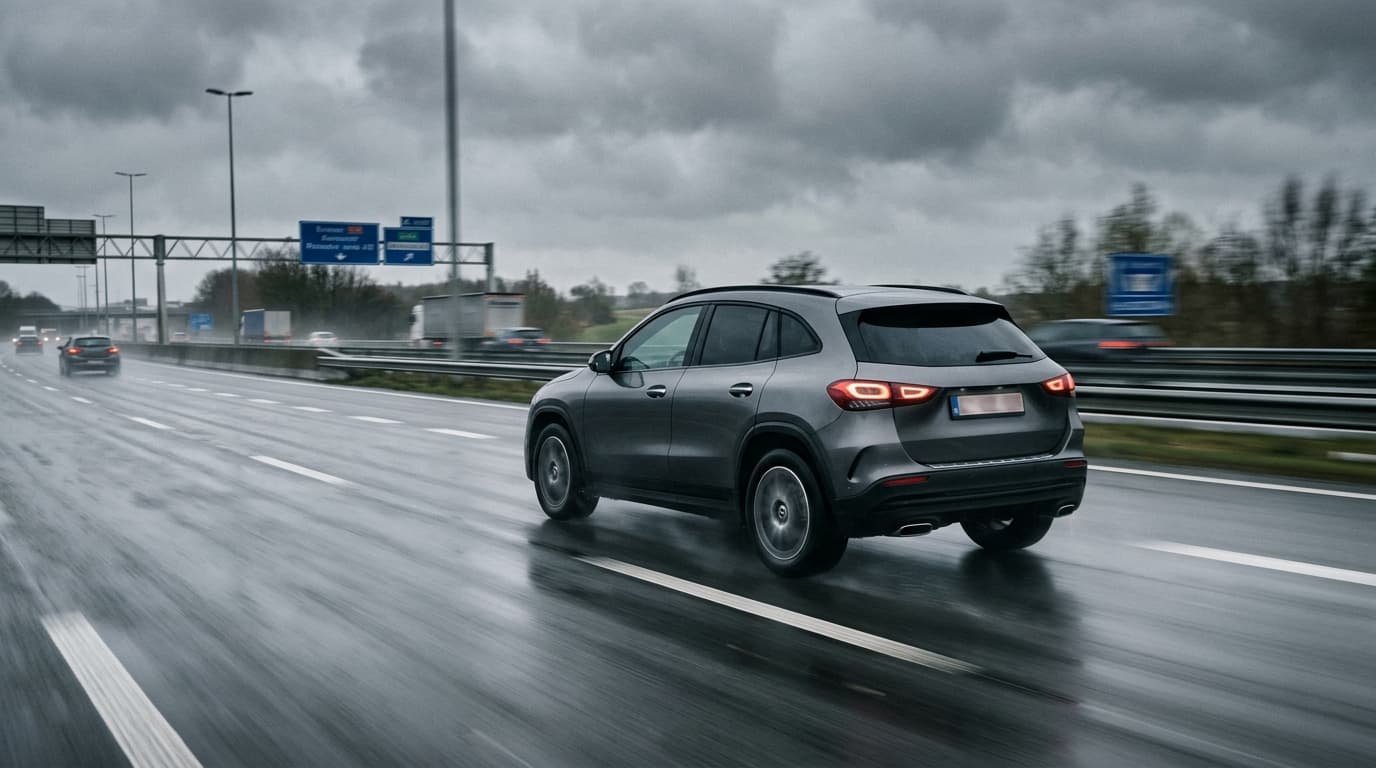
It depends entirely on charging. Charged every day on short trips, a PHEV SUV drops below 2 L/100 km. Never charged, it climbs to 7-9 L/100 km on the motorway, more than a full hybrid, which holds 5 to 6 L/100 km without ever seeing a plug.
That is the PHEV paradox: its official figure (often under 1.5 L/100 km on the WLTP cycle) assumes a full battery at the start. Once the battery is empty, the petrol engine has to haul 200 to 300 kg more than a normal petrol car, and consumption shoots up. The full hybrid, being lighter, keeps a steady figure whatever your charging habits — since there are none.
Road tests by L'Argus and ADAC measurements (2025) confirm it: with an empty battery, a compact PHEV SUV commonly burns 7 to 8.5 L/100 km at 120 km/h, where a RAV4 Hybrid or Sportage HEV settles around 5.5 to 6.5 L/100 km. The number that really matters: your share of trips under the PHEV's electric range. Above 60-70% of "charged" trips, the PHEV wins hands down; below that, the full hybrid takes the lead back.
Do you need a home charger for a PHEV SUV?
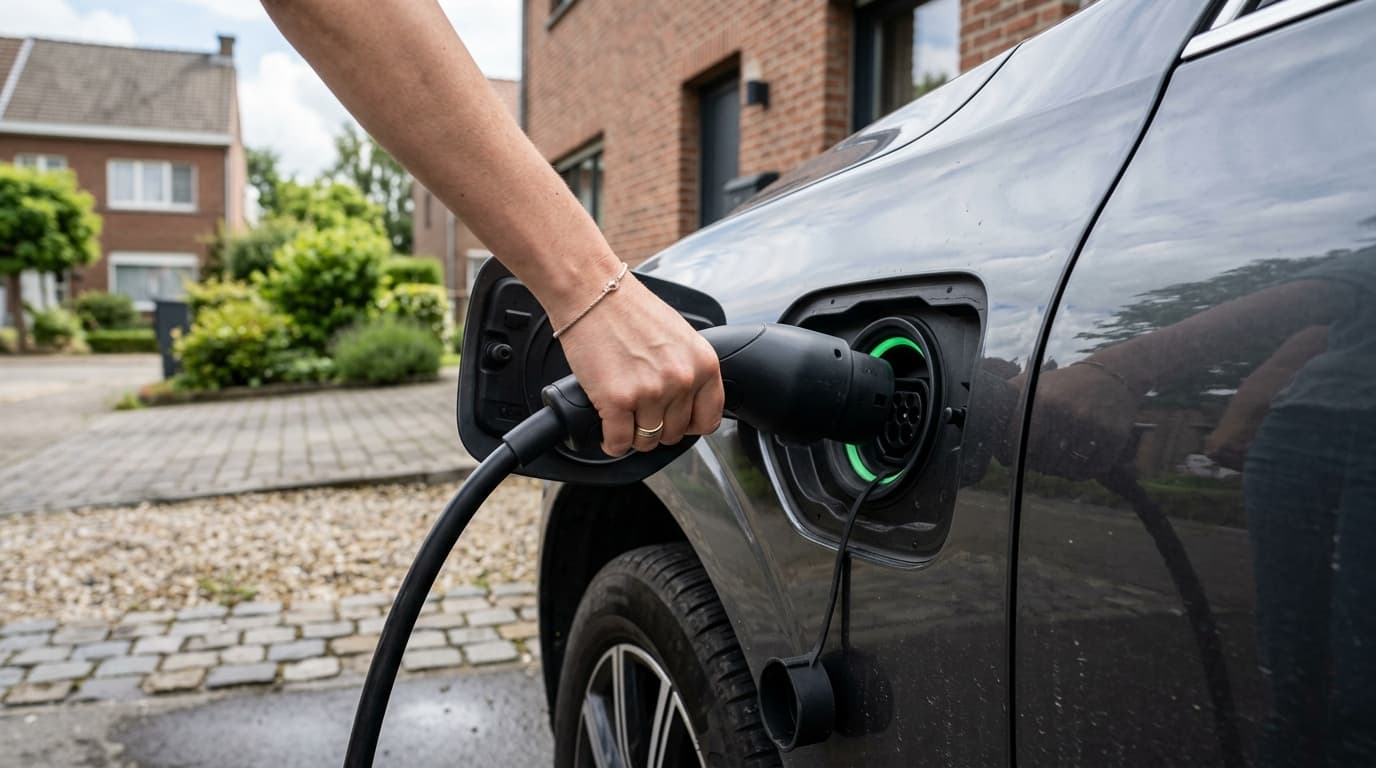
In practice, yes. A plug-in hybrid SUV only makes sense charged regularly. A simple reinforced socket in the garage is enough to charge overnight; without any accessible charging point, the PHEV loses all its value and drives like a weighed-down petrol car.
A PHEV SUV battery (10 to 25 kWh) charges in 3 to 6 hours on a home wallbox, or overnight on a reinforced socket. Most PHEVs do not accept DC rapid charging: forget the motorway charger, this is slow charging, at home or at work. That is exactly what makes access to a socket decisive.
On the Belgian market, a reinforced socket costs €300-600 fitted, a wallbox €800-1,500 depending on the installation. As of this article (July 2026), charging 15 kWh at home costs about €4 to €5 at the common residential rate, i.e. an electric "fill-up" for 50 to 70 km. What we'd avoid: buying a PHEV SUV while counting on public chargers — slow charging ties them up for hours and the per-kWh cost is far higher. To pick a specific model, see our ranking of the best plug-in hybrid SUVs.
Which is cheaper to buy and to run?
To buy, the full hybrid, almost always: expect €4,000 to €7,000 less than the equivalent PHEV. To run, the PHEV becomes cheaper only if you charge it regularly; otherwise its extra fuel use cancels the saving.
The price gap comes from the battery and charging electronics. On the same model, the plug-in version adds a few thousand euros. That gap has to be earned back through electric kilometres — and therefore through charging. Without a charger, you pay more for technology you don't use.
On the Belgian list (July 2026), the Kia Sportage starts around €38,000 as a full hybrid against about €43,000 as a PHEV; the Toyota RAV4 runs around €45,000 as a hybrid against ~€52,000 as a PHEV. In practice, that gives a simple decision rule: if you charge every day, the gap pays for itself in fuel over 3 to 4 years; otherwise the full hybrid is the rational choice from the first kilometre. What we'd avoid: choosing the PHEV for image or a tax promise without being able to plug it in.
PHEV or full hybrid: which is more tax-efficient in Belgium?
For a company, neither: a PHEV or full hybrid SUV ordered from 1 January 2026 no longer opens any deductibility (0%). Only the 100% electric stays deductible. For a self-employed sole trader (IPP), the PHEV keeps an edge over the full hybrid.
Belgium's car-tax reform pushes towards pure electric and gradually ends the deductibility of emitting powertrains. For company cars, hybrids — plug-in or not — ordered from 2026 fall to 0%. That is a heavy change for fleets and directors, and it reshuffles the deck between PHEV and full hybrid: on the company side, they are now equal, that is, at zero.
For a self-employed sole trader, the logic differs. Deductibility follows the formula 120% − (0.5% × g CO2/km). A PHEV SUV emitting 50 g CO2/km or less keeps about 75% deductibility; a full hybrid emitting 100 to 120 g falls towards 60-65%. As of this article (July 2026, sources Moniteur Automobile and Securex), the order date fixes the regime: check it before you sign. For the charge-free alternative, compare our ranking of the best non-plug-in hybrids.
Toyota RAV4: should you choose the PHEV or the hybrid version?
The RAV4 Hybrid if you can't charge or drive a lot on the motorway; the RAV4 PHEV if you plug in every day and want to run on electricity during the week. It is the same SUV, two uses, about €7,000 apart.
The RAV4 Hybrid (around €45,000 in Belgium, July 2026) remains the segment's reliability benchmark: proven mechanicals, 5.5 to 6.5 L/100 km with no constraint. The RAV4 PHEV (~€52,000) adds 75 km WLTP of electric range and all-wheel drive, but only makes sense charged.
In practice: for a 30 km commute with evening charging, the RAV4 PHEV runs almost entirely on electricity all week and only burns petrol at the weekend. For a sales rep clocking 40,000 km a year without reliable charging, the RAV4 Hybrid uses less fuel and costs €7,000 less. To dig into this model, read our full Toyota RAV4 hybrid review.
Comparison table: PHEV vs full hybrid SUV
| Criterion | Full hybrid SUV (HEV) | PHEV SUV (plug-in) |
|---|---|---|
| Battery | 1 to 2 kWh | 10 to 25 kWh |
| Electric range | 1 to 3 km | 50 to 90 km WLTP |
| Socket charging | No | Yes (essential) |
| Fuel use, empty battery | 5 to 6 L/100 km | 7 to 9 L/100 km |
| Fuel use, charged daily | — | < 2 L/100 km possible |
| Price (same model, BE) | from ~€38,000 | +€4,000 to €7,000 |
| Company deductibility 2026 | 0% | 0% |
| IPP deductibility 2026 | ~60-65% | ~75% (≤50 g) |
Indicative ranges, compact SUV segment, Belgian list price and tax regime as of 23/07/2026. WLTP manufacturer ranges; real-world use lower, more so in winter. Figures subject to change.
Which SUV should you choose for your profile?
In short: PHEV for anyone who charges at home and drives short during the week; full hybrid for anyone who drives a lot, without reliable charging, or who wants to keep the purchase price down. Your access to charging decides more than any spec sheet.
A family with a garage and a charger, commutes of 20 to 40 km: the PHEV SUV runs on electricity during the week and heads off on holiday with no range anxiety. A high-mileage driver or a flat-dweller without a socket: the full hybrid avoids the dead weight of the battery and the charging chore, while still using less than a petrol car.
In practice: ask yourself one question before signing — can I charge it at home, every day? If yes, the PHEV delivers; if no, the full hybrid is the rational choice. To fine-tune by budget and trips, put the models side by side with our comparison tool or take the quiz.
Verdict
Main choice: a PHEV SUV if — and only if — you can plug it in every day and your daily trips stay under its electric range. In that case, it runs on electricity during the week and slashes your fuel budget.
Alternative: a full hybrid SUV if charging is awkward, if you drive a lot on the motorway, or if you want to keep the purchase price down. It uses less than a petrol car with no constraint, for €4,000 to €7,000 less than an equivalent PHEV.
The real dividing line is not the spec sheet, it is your garage socket. Answer that question first, and the rest follows.
Sources: L'Argus road tests 2025, ADAC Autotest 2025, manufacturer data 2026, Belgian dealer list prices as of 23/07/2026 (moniteurautomobile.be, lizy.be, autoscout24.be), company-car and self-employed IPP tax regime — Moniteur Automobile and Securex (January 2026). WLTP ranges, real-world use lower. Prices subject to change.
Comparateur SUV
Compare tous les suv côte à côte.
Comparer maintenant →
Frequently asked questions
Julien essaie des voitures depuis 2012, d’abord pour la presse spécialisée belge, aujourd’hui en indépendant depuis Liège. Il croise les données TÜV, ADAC et les prix catalogue belges plutôt que les fiches constructeur. Sa règle : pas d’essai en concession de 20 minutes, pas de verdict sans chiffre vérifiable.