SUV
Brake pads in Belgium: what they cost, from €99 to €250
Brake pads in Belgium: €99 on average, around €250 with the front discs. Replacement intervals, the 3 mm limit and the real cost per kilometre.
A brake pad change costs €99 on average in Belgium. With both front discs, a typical bill rises to around €250. The replacement limit is 3 mm of friction material, and everything else depends on how you drive.
How much do brake pads cost in Belgium?
€99. That is the average observed price for a pad change, including fitting and a brake fluid level check, on the Belgian idGarages page read on 21 October 2026. The page gives neither a survey date nor a labour rate, and we found no other rate on a readable Belgian source.
A set of pads alone sells for €35 to €80 per axle in standard quality, and from €15 to €200 depending on composition (metallic, semi-metallic, ceramic or organic). The price gap comes from the part as much as from the fitting.
| Catalogue model | Pads alone | Pads and front discs |
|---|---|---|
| Renault Clio III 1.5 dCi 75 | €43.35 to €142.75 | €114.83 to €636.85 |
| VW Golf VII 1.6 TDI 105 | €86.41 to €157.40 | €169.80 to €484.25 |
| Nissan Qashqai Ph2 1.5 dCi 106 | €63.84 to €107.80 | €163.33 to €354.00 |
| Audi A3 III 1.4 TFSI 150 | €83.82 to €192.20 | €265.94 to €515.95 |
The source does not say whether these ranges include fitting, and they cover previous generations of each model. Treat them as an order of magnitude, not a quote. The Qashqai, the only SUV in the list, stays within the Golf's range, with a €44 gap between the minimum and maximum for its pads against €71 for the Golf.
Pads alone or with the discs: what does the bill look like?
Around €250 for pads and both front discs, with about two hours of labour. The two discs alone cost €50 to €200 depending on model and material, and four standard pads about €50, according to the idGarages page on discs.
The garage proposes the full set when the disc is scored, warped or below its minimum thickness. A disc carries a minimum thickness engraved on its edge. Ask for the measured value and that minimum: without both figures, replacing the disc is an opinion.
How many kilometres between pad changes?
It depends on driving, and sources disagree. The idGarages guide on pads counts 15,000 km in town and up to 30,000 km on motorways. Its guide on discs gives 30,000 to 40,000 km at the front, 50,000 to 70,000 km at the rear, and 60,000 to 80,000 km for a disc. On one website, two ranges that differ by a factor of two.
Here is our calculation, assumptions shown: €99 for one axle, €250 for pads and front discs, 15,000 km a year.
| Scenario | Cost | Km between changes | Per 1,000 km | Per year |
|---|---|---|---|---|
| Pads alone, town | €99 | 15,000 | €6.60 | €99.00 |
| Pads alone, motorway | €99 | 30,000 | €3.30 | €49.50 |
| Pads and front discs | €250 | 30,000 | €8.33 | €125.00 |
| Pads and front discs | €250 | 40,000 | €6.25 | €93.75 |
The figure that really matters: an urban driver pays twice as much per kilometre for pads as a motorway driver.
At what thickness should pads be replaced?
At 3 mm of friction material, replacement is immediate, according to idGarages. A new pad measures 10 to 15 mm depending on the page, and the exact limit varies slightly between manufacturers: the service booklet decides.
| Sign observed | What to do |
|---|---|
| Steady orange pad warning light | Have the pad thickness measured; the fault may also be in the electrical circuit |
| Metallic squeal when braking | Replace soon, the disc may already be scored |
| Car pulls to one side under braking | Immediate check at a garage |
| Soft pedal, longer stopping distance | Do not wait, see a garage the same day |
| Vibration through the pedal | Have the discs checked, probably warped |
| Friction material measured at 3 mm or less | Immediate replacement |
An orange pad light is not an engine light: for that one, our article on the orange check engine light gives the steps to follow.
Does an SUV or an electric car wear its brakes differently?
Yes, in opposite directions.
At equal speed, the energy to dissipate when braking grows with mass: a 1,800 kg SUV carries 50% more than a 1,200 kg compact. That is physics, not a measurement, and no Belgian source we read quantifies the difference in lifespan. Expect pads that need checking more often rather than a heavier bill, as the Qashqai above shows.
On an electric car or hybrid, regenerative braking slows the car before your foot reaches the pedal. Wikipedia, citing G. Guillossou (2020), notes that these cars wear their discs and pads less. Automobile Propre (25 September 2026) gives the flip side: pads are spared, but discs, used less, are more exposed to corrosion, especially in the rain, outdoors or after a long period of standing. The saving is real, and it is paid for in rusty discs. Our comparison of electric versus hybrid total cost puts these items in a full bill.
Will the technical inspection fail worn brakes?
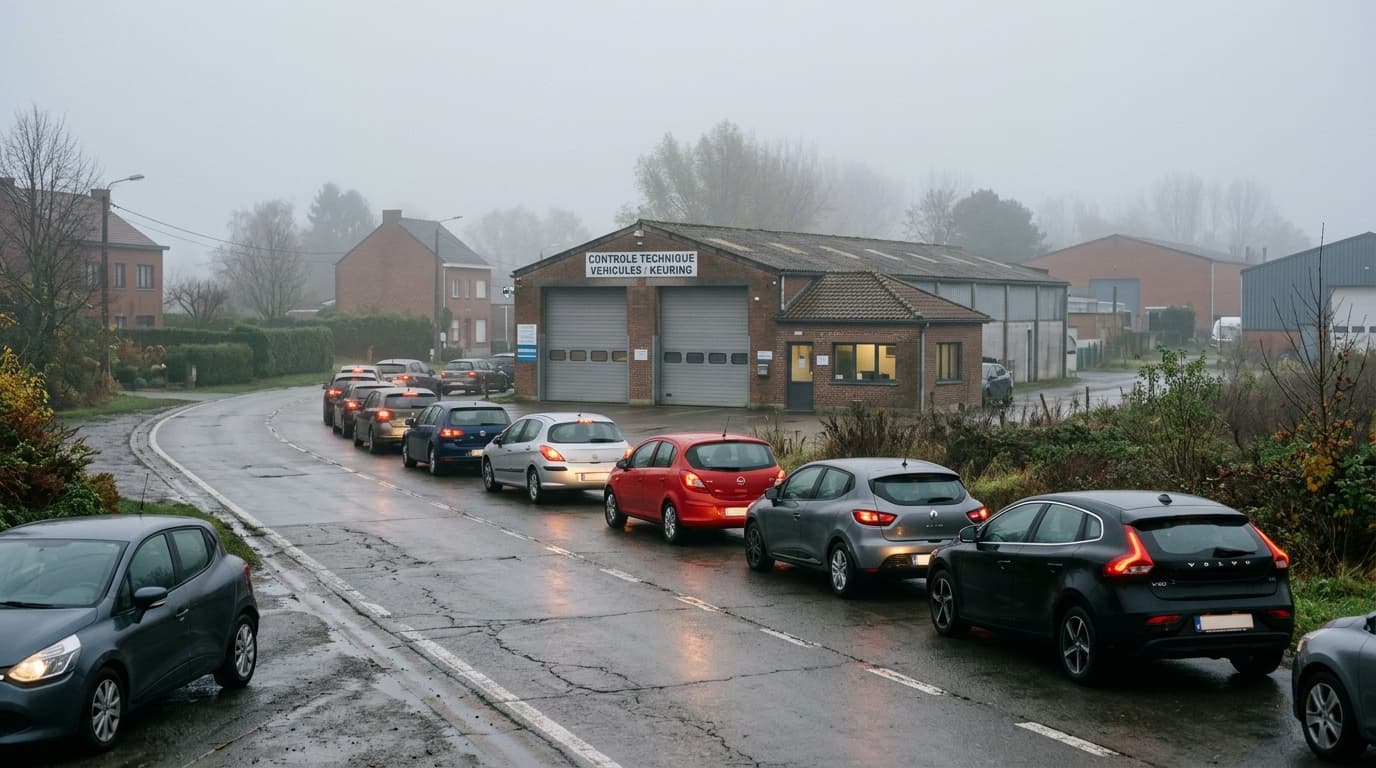
It checks that the brakes act evenly and with sufficient force, according to AutoScout24 (12 June 2026). No source we read gives the numerical efficiency threshold or the list of brake-related failures, and we do not invent them. General rules are on Belgium.be.
The inspection rhythm differs by Region. In Brussels and Wallonia, the car goes every year. In Flanders, since 1 September 2026, it is every two years after the first visit, according to vlaanderen.be. At 15,000 km a year, two years means 30,000 km, the whole interval of a set of pads in urban use. A Flemish owner should therefore have the pads measured at servicing rather than wait for the station. Our article on the technical inspection in Flanders details the calendar.
Which mistakes inflate the bill?
Five come up again and again.
- Driving on after the metallic squeal: the friction material is gone, the backing plate bites into the disc, and €99 becomes €250.
- Changing a single pad: they are replaced in pairs, on one axle.
- Ignoring the orange light without having the electrical circuit checked.
- Accepting a quote with no measured thickness and no disc minimum.
- Comparing a parts-only price with a price including fitting.
Verdict: €99 per axle, €250 with the discs, but measure first
Budget €50 to €125 a year at 15,000 km, depending on your use, and ask for two figures before signing: the friction material thickness and the disc minimum. That is our recommendation.
The alternative, for those who mostly drive on motorways: let the pads live down to 3 mm, the interval can then approach 30,000 km, and a kilometre costs half what it costs a city driver. If you are buying a used car, have the brakes measured before you sign, and read our guide to the pre-sale technical inspection.
Sources: idGarages, brakes (Belgian version) and idGarages, discs and pads (pages read on 21 October 2026, no price survey date) · idGarages, brake pad warning light page (read on 21 October 2026) · Automobile Propre, 25 September 2026 · Wikipedia, disc brake (French) · AutoScout24, technical inspection (12 June 2026) · vlaanderen.be, when to go for the technical inspection · Belgium.be, technical inspection. Per-kilometre costs are our calculation, on the stated assumptions. Per-model prices are those of the idGarages catalogue, with no detail on fitting. No vehicle was tested for this article.
Comparateur SUV
Compare tous les suv côte à côte.
Comparer maintenant →
Frequently asked questions
Julien essaie des voitures depuis 2012, d’abord pour la presse spécialisée belge, aujourd’hui en indépendant depuis Liège. Il croise les données TÜV, ADAC et les prix catalogue belges plutôt que les fiches constructeur. Sa règle : pas d’essai en concession de 20 minutes, pas de verdict sans chiffre vérifiable.