Électriques
Company Electric Car Benefit in Kind in Belgium
Benefit in kind (ATN) of a company electric car in 2026: list value × 6/7 × 4 %, minimum €1,690. Below €49,291.67 every EV pays the same. Sums redone.
The benefit in kind (ATN) of a company electric car is calculated as list value including VAT × 6/7 × 4 %, with a minimum of €1,690 a year in 2026. Below €49,291.67 of list value, every electric car therefore pays exactly the same benefit, which is €140.83 a month added to your taxable base.
That floor changes how you choose. A €28,000 electric car and a €48,000 one weigh the same on your payslip, and it is then the price of the car, not the benefit in kind, that should guide the choice.
How is the benefit in kind of an electric car calculated in 2026?
Four ingredients: the list value, the 6/7 coefficient, the CO2 percentage and the age coefficient.
The list value is the public price including VAT of the version, options included, before any discount. The CO2 percentage is 4 % for a zero-emission car, which is the floor of the scale. A combustion car starts from 5.5 % and adds or subtracts 0.1 point per gram of CO2 around a reference emission set for 2026 at 70 g/km for petrol and 58 g/km for diesel. An electric car emits 0 g: it stays at the floor. The age coefficient is 1 in the first year.
The result: value × 6/7 × 4 % × age coefficient, never below €1,690 for 2026 income (BNP Paribas Fortis, accessed 3 October 2026, minimum confirmed by Van Mossel Westlease).
In practice, that gives a simple rule: a €3,000 discount won at the dealership does not lower your benefit in kind by a cent.
Why does a €28,000 electric car pay the same benefit in kind as a €48,000 one?
Because the legal minimum catches both of them.
The threshold comes out of one division: 1,690 ÷ (4 % × 6/7) = €49,291.67. Below it, the raw calculation falls under the minimum and the minimum applies. A €25,000 car shows €857.14 on the raw calculation: the floor nearly doubles it.
| List value incl. VAT | Raw calculation (value × 4 % × 6/7) | Benefit in kind used per year | Per month |
|---|---|---|---|
| €25,000 | €857.14 | €1,690.00 | €140.83 |
| €35,000 | €1,200.00 | €1,690.00 | €140.83 |
| €45,000 | €1,542.86 | €1,690.00 | €140.83 |
| €49,291.67 | €1,690.00 | €1,690.00 | €140.83 |
| €55,000 | €1,885.71 | €1,885.71 | €157.14 |
| €65,000 | €2,228.57 | €2,228.57 | €185.71 |
| €80,000 | €2,742.86 | €2,742.86 | €228.57 |
Calculations redone on 3 October 2026, first year in service, age coefficient of 1, 2026 income.
The figure that really counts: €49,291.67. Above it, every €1,000 of list value adds €34.29 of benefit in kind a year.
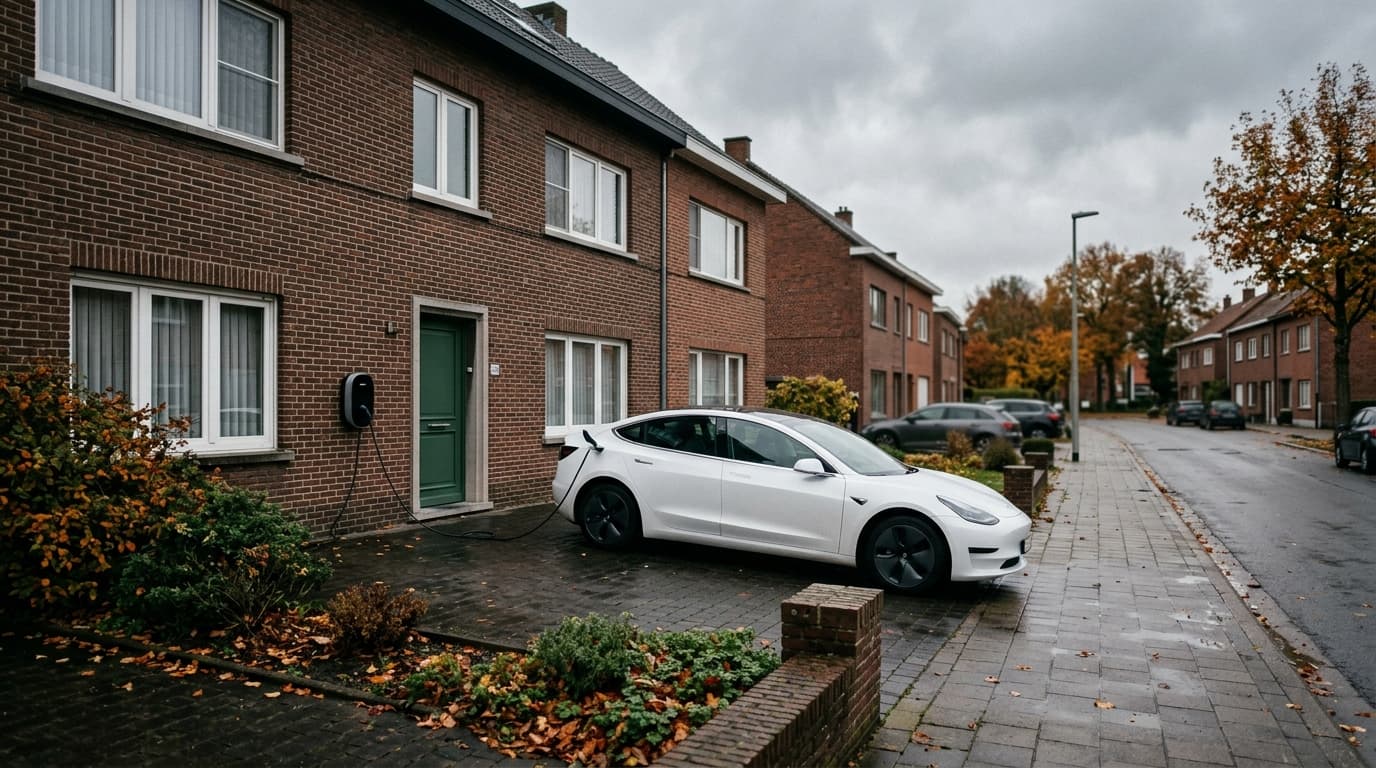
How much does the benefit in kind really cost on your payslip?
Less than people think, and it is not a sum you pay.
The benefit in kind is added to your taxable income, and tax is worked out at your marginal rate. The €1,690 minimum therefore costs €676 a year at 40 % (€56.33 a month), €760.50 at 45 % (€63.38) and €845 at 50 % (€70.42). The calculation leaves out the municipal surcharge, which varies from one municipality to another, and your marginal rate depends on your salary: ask your payroll provider before comparing two car policy offers.
Does a petrol or diesel car of the same price pay more benefit in kind?
At a €45,000 list value, the gap reaches €2,360 of benefit in kind a year.
| List value | Electric (4 %) | Petrol at 120 g/km (10.5 %) | Diesel at 110 g/km (10.7 %) |
|---|---|---|---|
| €35,000 | €1,690.00 | €3,150.00 | €3,210.00 |
| €45,000 | €1,690.00 | €4,050.00 | €4,127.14 |
| €55,000 | €1,885.71 | €4,950.00 | €5,044.29 |
Worked examples, not specific models. 2026 references of 70 g for petrol and 58 g for diesel, percentage capped at 18 %. Calculations redone on 3 October 2026.
The electric car costs 1.9 to 2.6 times less in benefit in kind. At €45,000, the €2,360 gap represents €944 net at a 40 % marginal rate, every year you keep the car.
Do options push up the benefit in kind of an electric car?
Only above €49,291.67.
Below the threshold the margin is free: on a €45,000 electric car you have €4,291.67 of options that do not change the benefit in kind by a euro. Above it, the bill follows the list value, and every €1,000 costs €34.29 of benefit in kind a year, roughly €13.71 net at 40 %.
| Configured list value | Situation | What to do |
|---|---|---|
| Under €49,291.67 | €1,690 minimum | Tick the useful options up to the threshold, the benefit in kind does not move |
| €49,291.67 to €55,000 | Just above | Weigh each €1,000 at €34.29 of benefit in kind a year |
| Over €55,000 | Raw calculation | Negotiate the version, not the discount: the discount is not part of the value |
| Over €60,000 originally, three years old | Coefficient 0.82, so €1,686.86 | The €1,690 minimum takes over again |
Four checks before signing the order form:
- Is the total including VAT and options on the form, separate from the discount?
- Does it stay under €49,291.67, or by how much does it exceed it?
- Is the CO2 on the certificate of conformity really 0 g?
- Has the employer calculated the benefit in kind on that value, and not on the discounted price?
Age only matters above the floor
The age coefficient loses 6 % a year after the first year and stops at 70 % from 61 months (BNP Paribas Fortis). On an electric car with an original value of €60,000, the benefit in kind goes from €2,057.14 in the first year to €1,933.71 in the second, then €1,810.29 in the third, before falling back to the €1,690 minimum from the fourth.
Buying second-hand to cut your benefit in kind therefore only works on a car that was expensive when new. Below the threshold, age changes nothing.
Is a company electric car still deductible in 2026?
Yes, at 100 % for the employer if ordered in 2026, then 95 % in 2027, 90 % in 2028, 82.5 % in 2029, 75 % in 2030 and 67.5 % in 2031 (BNP Paribas Fortis, declining schedule). The order date counts, not the delivery date.
Two bills, two payers: the benefit in kind weighs on you, the deductibility on the company. A petrol or diesel car ordered in 2026 is no longer deductible at all, and neither is a plug-in hybrid for a company. For a plug-in hybrid, the benefit in kind stays at 4 % if it counts as a genuine hybrid: our ranking of plug-in hybrids works out the same floor model by model.
Does the benefit in kind change from one Region to another?
No. The benefit in kind falls under federal personal income tax: it is calculated the same way in Arlon, Ixelles and Ghent.
The taxes attached to registration, on the other hand, differ. On 1 January 2026 Flanders ended the exemption for electric vehicles and now taxes their registration, at €61.50 according to BNP Paribas Fortis. In Brussels, the Belgian catalogue showed €61.50 of registration tax for the electric Citroën ë-SpaceTourer (recorded on 6 September 2026). In Wallonia, the formula in force since 1 July 2025 crosses power, CO2, mass and fuel. The detail is in our article on registration tax and in the one on the annual road tax in Wallonia.
Our verdict
Configure your electric car up to €49,291.67 of list value, not a euro more, and choose the model on how you will use it: the benefit in kind will be €1,690 whatever you tick below that.
The alternative, if the version that suits you goes over the threshold: count €34.29 of benefit in kind per €1,000, which is €13.71 net a year at 40 %. We would avoid negotiating a discount in the belief that it lowers the benefit in kind, since the discount is not part of the calculation. For the self-employed, see our article on the company car for the self-employed, and for the overall cost against a hybrid, electric vs hybrid: the real total cost. The comparison tool lines up Belgian list prices.
Sources: BNP Paribas Fortis, company car benefit in kind (accessed 3 October 2026), BNP Paribas Fortis, deductibility of company cars (accessed 3 October 2026), Van Mossel Westlease, 2026 changes (accessed 3 October 2026), FPS Finance, company cars.
Comparateur Électriques
Compare tous les électriques côte à côte.
Comparer maintenant →
Frequently asked questions
Julien essaie des voitures depuis 2012, d’abord pour la presse spécialisée belge, aujourd’hui en indépendant depuis Liège. Il croise les données TÜV, ADAC et les prix catalogue belges plutôt que les fiches constructeur. Sa règle : pas d’essai en concession de 20 minutes, pas de verdict sans chiffre vérifiable.