Hybrides
WLTP explained, and why real fuel use runs higher
WLTP is the EU type-approval cycle. Its fuel figures run 14% below the road, up to 5 times on a plug-in hybrid. Belgian numbers as of 13 Oct 2026.
WLTP is the laboratory test that sets the official fuel consumption and CO2 of every new car sold in Belgium. It has replaced NEDC since 2018 and returns higher figures, so more honest ones. But it remains a laboratory test: the road exceeds it by 14% on average, and by three to five times on a plug-in hybrid.
WLTP (Worldwide Harmonised Light Vehicles Test Procedure) is the type-approval procedure harmonised at world level, described on Wikipedia.
WLTP, NEDC or the road: who measures what?
Three measurements coexist on the Belgian market, and they do not answer the same question. NEDC, forty years old, still sits in used-car listings from before 2018. WLTP covers every new car. The road is the only figure you actually pay for.
| Criterion | NEDC (before 2018) | WLTP (since 2018) | Road |
|---|---|---|---|
| Duration | 20 min | 30 min | variable |
| Distance | 11 km | 23.25 km | variable |
| Average speed | 34 km/h | 46.5 km/h | variable |
| Top speed | about 120 km/h | 131 km/h | 120 to 130 km/h on motorways |
| Time stationary | 25% | 13% | variable |
| Temperature | 20 to 30 °C | 23 °C (CO2 corrected to 14 °C) | variable |
| Verdict | too favourable | more realistic, still favourable | the reference |
WLTP cycle: Toyota Ireland page, read on 13 October 2026. NEDC and stationary time: TotalEnergies. NEDC top speed is inferred from the 10 km/h gap that source states, not read directly.
WLTP runs in four phases of rising speed, from the 18.9 km/h average of the low phase to the 92 km/h of the extra-high phase, according to Fiches-auto. It applied to new models from 1 September 2017, then to all new car registrations from 1 September 2018.
Why does the laboratory test always come out below the road?
Because it measures a car on rollers, at 23 °C, with nobody to make it suffer. A laboratory has no hill, no wind and no hard braking.
Four causes explain most of it:
- heating and air conditioning are switched off during the test;
- the temperature stays mild, whereas Belgian cold raises the consumption of every engine;
- accelerations follow a fixed trace, with no overtaking and no traffic jam;
- charging losses are not counted for an electric car.
That does not make WLTP useless. It compares two cars under identical conditions, which the road never does, and that is why it serves as the legal basis. It is the reading of the absolute value that misleads, not the comparison.
The gap in numbers: 14%, 15%, then three to five times
Three serious studies measure three different gaps, and they need to be kept apart.
| Type of car | Gap with the official figure | Source and sample |
|---|---|---|
| Petrol, diesel, conventional hybrid | about 8% in 2018, 14% in 2022 | ICCT, more than 160,000 cars, summary of 1 February 2024 |
| Electric (range) | 9 to 27% of claimed range too much, 15% on average | Test-Achats, 31 models, 7 August 2025 |
| Plug-in hybrid (consumption) | three to five times | ICCT, June 2022, about 9,000 cars |
The trajectory of the first row is the point to keep: the relative gap has grown by about 80% since 2018, because official figures fell by 7.3% between 2018 and 2022 while real consumption fell by only 2.3%. Official figures are therefore improving faster than lived consumption.
For electric cars, Test-Achats divides the usable battery capacity by the WLTP consumption. The association cites the electric Ford Puma: 328 km estimated against 376 km claimed. Our article on real range according to ADAC gives road measurements to compare.
How much does the gap cost at the pump in Belgium?
The calculation is simple and nobody publishes it in Belgian euros. The official maximum price of Super 95 (E10) has been €2.108 a litre since 26 September 2026, according to La DH and the federal economy department. At 15,000 km a year:
| Case | Consumption | Annual budget at maximum price |
|---|---|---|
| Petrol at the WLTP figure | 5.0 l/100 km | €1,581.00 |
| Same petrol car, 14% ICCT gap | 5.7 l/100 km | €1,802.34 (+€221.34) |
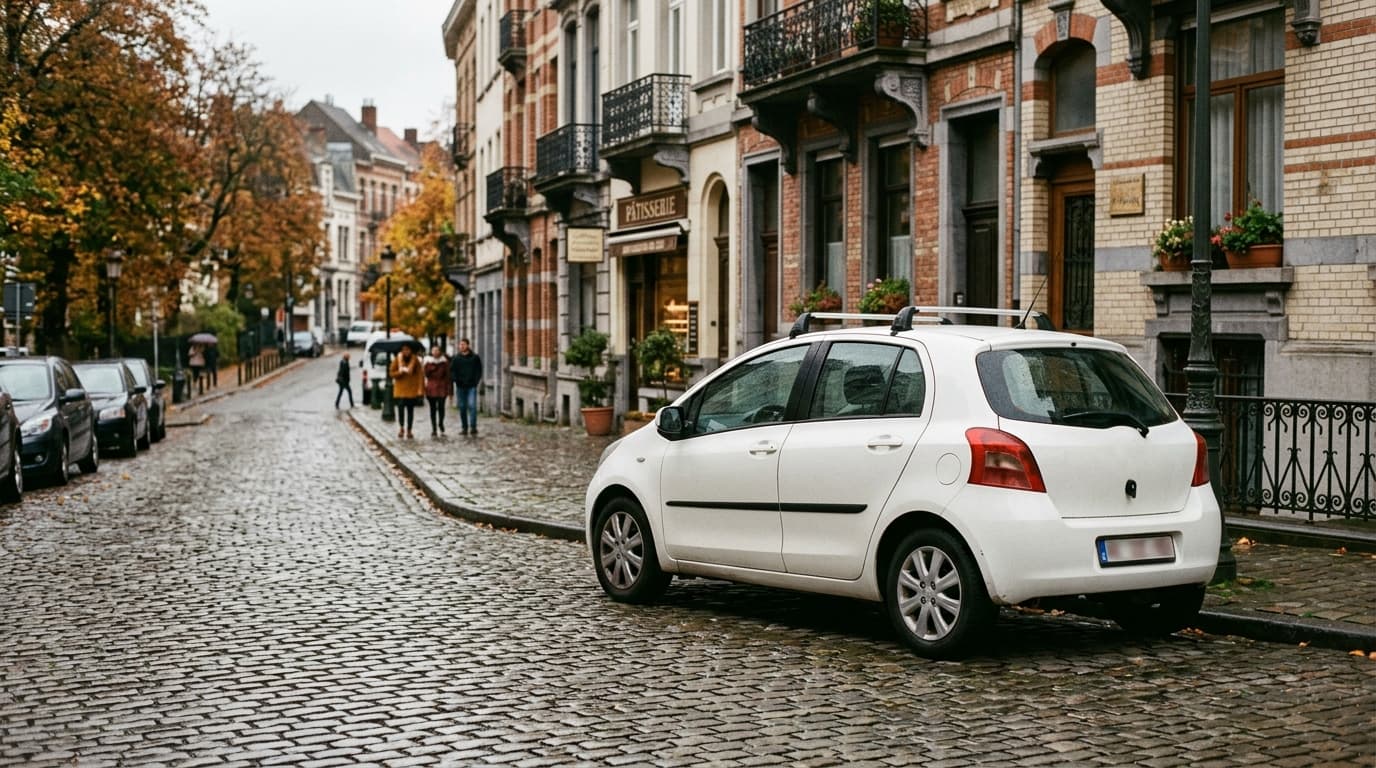
| Toyota Yaris hybrid, WLTP | 3.8 l/100 km | €1,201.56 |
| Toyota Yaris hybrid, recorded consumption | 5.5 l/100 km | €1,739.10 (+€537.54) |
| Plug-in hybrid, private use, WLTP | 1.65 l/100 km | €521.73 |
| Plug-in hybrid, private use, ICCT | 4.2 l/100 km | €1,328.04 (+€806.31) |
| Plug-in hybrid, company car, ICCT | 8.0 l/100 km | €2,529.60 (+€2,007.87) |
Calculations of 13 October 2026, fuel only, without the electricity used for charging. The 5.0 l/100 km is a generic profile. The Yaris reading comes from our Yaris hybrid review. The plug-in hybrid values are the midpoints of the ICCT ranges.
On the Yaris, the gap is not 14% but 44.7%. It varies a lot from one model to another, and the ICCT average hides much worse cases.
WLTP decides your tax, not your fuel bill
Here is the Belgian paradox: the administration reads the laboratory figure and ignores the road. The WLTP CO2 on the certificate of conformity underpins three taxes, and none is corrected because your car uses more.
| Region or regime | Reads WLTP CO2? | What weighs instead |
|---|---|---|
| Flanders (registration tax) | yes | Euro standard, fuel, age |
| Wallonia (registration tax) | yes | power, mass, energy |
| Brussels (registration tax) | no | power in kW or CV, whichever is higher |
| Company car (benefit in kind) | yes | list value, age |
Regional regimes: our registration tax article and our readings of 9 September 2026.
For the benefit in kind, the mechanics can be quantified. According to the 2026 values used in our article on the benefit in kind of a company car, the rate starts at 5.5% and moves by 0.1 point per gram of CO2 against a reference of 70 g/km for petrol. On a petrol car with a €35,000 list value, which is €30,000 once multiplied by six sevenths, every 10 g adds €300 of taxable benefit a year: €2,850 at 110 g, €3,150 at 120 g, €3,450 at 130 g.
One consequence that dealers rarely mention follows. Two cars that use the same fuel on the road can sit €300 apart in tax each year, simply because one went through the laboratory test with 10 g less.
Plug-in hybrid: the figure that is wrong the most
The official figure of a plug-in hybrid assumes the driver charges it almost every day. Drivers do not follow.
The ICCT measures 45 to 49% of kilometres on electricity for private owners and 11 to 15% for company cars, against 70 to 85% assumed by WLTP. Average consumption goes from 1.6 l/100 km official to 4.0 to 4.4 l for the former, and to 7.6 to 8.4 l for the latter. In other words, a company plug-in hybrid often drinks like a large petrol car.
The consequence for Belgium is uncomfortable: the benefit in kind of a company plug-in hybrid is calculated on a figure the road contradicts. Our guide to plug-in hybrid taxation details the amount, and our plug-in hybrid ranking classes these cars only on that tax criterion: their real appeal depends on daily charging.
What should you do with this figure before buying?
To compare the official figures of several models side by side, the comparison tool shows the WLTP consumption of the models it lists.
Sources: Wikipedia, WLTP · Toyota Ireland, WLTP page (cycle, entry-into-force dates) · TotalEnergies, WLTP standards (NEDC comparison) · Fiches-auto, WLTP cycle · ICCT via New Mobility, 1 February 2024 · ICCT, plug-in hybrid fact sheet, June 2022 · Test-Achats, 7 August 2025 · La DH, maximum price of 26 September 2026. Calculations of 13 October 2026. Consumption profiles are generic, except the Yaris, whose reading appears in our review. The official pages of the Federal Public Service Finance and the Flemish tax portal could not be re-read on 13 October: tax rules come from our dated articles.
Comparateur Hybrides
Compare tous les hybrides côte à côte.
Comparer maintenant →
Frequently asked questions
Julien essaie des voitures depuis 2012, d’abord pour la presse spécialisée belge, aujourd’hui en indépendant depuis Liège. Il croise les données TÜV, ADAC et les prix catalogue belges plutôt que les fiches constructeur. Sa règle : pas d’essai en concession de 20 minutes, pas de verdict sans chiffre vérifiable.